One practical implementation and measurement guide for improving how hotels are found, represented, recommended, and verified in AI-mediated discovery.
Includes free, reusable tools for each repeatable part of the workflow.
One ordered workflow for improving how a hotel is found, described, and recommended
Executive recommendation
AI visibility is not adequately described by a page rank. A hotel is visible when AI systems can resolve the correct property, understand its facts and relationships, retrieve useful evidence, represent it accurately, include or recommend it for relevant traveler needs, cite credible sources, and identify a valid next action when the use case requires one.
Publish a transparent method before publishing any composite score. Declare the property and market, tested surfaces and product modes, versioned prompts, repeated-sampling protocol, evidence, formulas, source precedence, cadence, eligibility rules, and limitations. Keep foundational readiness and observed visibility in separate reports because they answer different questions.
Why AI visibility is not a ranking
Traditional search often moves from query to ranked links to a site. AI-mediated discovery can move from intent through research, retrieval, synthesis, recommendation, and an action without a site visit. A position alone cannot show whether the correct hotel was resolved, trusted, represented accurately, or given a useful path.
Discovery mechanic
Intent expansion and retrieval
One traveler request can imply location, amenity, policy, comparison, availability, and experience needs, so test realistic intent sets rather than isolated keywords.
Content principle
Evidence and information density
Clear, current, self-contained facts with adjacent support are more measurable than content volume by itself.
Delivery mechanic
Machine-readable delivery
Canonical HTML, structured data, feeds, APIs, and relationships can aid access and interpretation, but implementation mechanisms are not outcomes.
Client discipline
Different machine purposes
Indexing, answer retrieval, model training, and action are not interchangeable. Every access or policy check must name the client and purpose being tested.
Two measurement tracks — kept side by side, never blended
Foundational readiness
Can a public reviewer determine that the hotel's information is accessible, unambiguous, retrievable, consistent, and action-ready? Use either a public outside-in review or clearly disclosed owner-assisted validation against private systems of record.
Observed visibility
What do declared AI surfaces return, how often, with what representation and evidence, under a repeatable test protocol? Repeated sampling is required because answers vary by prompt, product mode, account state, market, and time.
A hotel may be technically ready yet absent from recommendations, or visible despite readiness defects. Report the two tracks together for diagnosis, but never convert them into one score.
One ordered workflow
Define the target guest and the property's genuine uniqueness.
Audit the hotel's own site and retrieval readiness.
Prepare clear, consistent, and credible content.
Audit what AI answer surfaces actually say.
Measure presence, accuracy, and recommendation or influence separately.
Remediate the source of each failure and re-test.
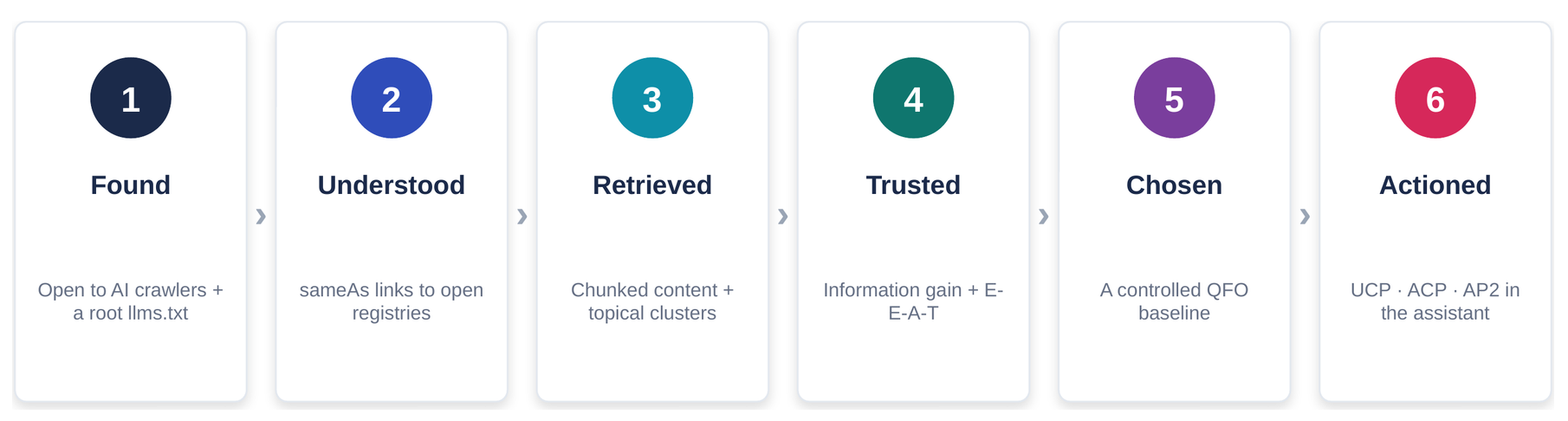
Use the six-stage lifecycle as a diagnostic, not a score
01Found
Can relevant clients reach the evidence?
Check crawl access, delivery, rendering, and indexing signals.
02Understood
Is the correct hotel entity unambiguous?
Check identity, attributes, identifiers, and relationships.
03Retrieved
Are useful answer units extractable?
Check intent coverage, page depth, structure, and readable facts.
04Trusted
Do sources agree and support the claims?
Check parity, freshness, corroboration, and evidence quality.
05Chosen
Is the hotel included or recommended?
Use repeated answer-side tests; do not infer this from readiness.
06Action-ready
Is a current official path identifiable?
Assess the path and public data only; do not claim a completed transaction.
The guide does not promise that a technically correct site will appear in AI answers, and it does not treat one favorable answer as proof of performance. Indexing and retrieval readiness are foundational, but not sufficient.
Four hospitality standards to keep in view
These site-side statements are hospitality-specific. General web specifications do not describe everything a hotel needs to publish, so they complement — not replace — the official specifications listed in Resources. These are implementation statements, not scoring weights; evidence classifications are shown where assigned.
Hospitality standard
Lodging schema completeness
The property publishes complete lodging-type structured data covering rooms, amenities, rate context, and location rather than a minimal organization stub. Evidence: Signaled. Route: Agency or Auto.
Hospitality standard
Guest-question content
The site answers, in the property's own words, the questions travelers actually ask — in extractable page text, not in PDFs, images, or steps inside a booking flow. Evidence: Signaled. Route: Content.
Hospitality standard
Entity corroboration
Core identity facts are consistent across the sources machines cross-check. Third-party and OTA profiles function as corroborating assets for the entity, not as competitors to it. Correct thin or contradictory profiles rather than treating them as the enemy.
Hospitality standard
Destination context depth
The property publishes substantive neighborhood and destination context, not only on-property facts. Destination context is central to unbranded discovery questions such as where a traveler should stay near a place or experience. Evidence: Signaled. Route: Content.
Where this sits against SEO
AEO is not simply SEO under a new name. It is grounded in strong technical SEO, but optimizing for a retrieval system that composes an answer is a different problem from optimizing for a ranked list of links.
Myth 01
“AEO is just SEO.”
Different AI systems prioritize different data. Some partner with specific review or travel platforms, some draw on their own ecosystem, and some on their own social data. A property optimized for one is not thereby optimized for all.
Myth 02
“Low AI referral traffic means AI visibility does not matter.”
Zero-click interactions — where the system answers the traveler's question without sending them anywhere — are a large and largely invisible share of AI-mediated discovery.
Myth 03
“There is a platform to optimize for.”
Prioritize universal principles that apply across systems over guidance tuned to any single platform.
Scope boundary
This guide covers visibility and discovery. Static property information and dynamic availability, rate, and inventory information are in scope only insofar as they influence whether a property can be discovered or filtered. The outer boundary is what happens once a traveler or system moves from discovery into a commercial transaction. Transaction execution, payment, booking completion, conversion, revenue attribution, and emerging commerce protocols are outside this public flow. A useful official path and current rate or availability can be recorded only as pre-transaction readiness signals, never as proof of a booking or commercial result.
The approach is platform-neutral. It treats answer engines as changing surfaces and focuses on repeatable evidence rather than optimization promises tied to one provider.
Execution profiles
Execution profile
SMB / independent · Property level
Use a small approved profile set, the site-side checklist, a bounded multi-engine check, a fixed prompt sample, manual answer capture, the truth set, and a monthly review. Use agencies or vendors for technical checks that require access.
Execution profile
Enterprise · Corporate level
Maintain shared entity and attribute standards, a core prompt library with property exceptions, portfolio truth-set governance, approved measurement tools, multilingual and market coverage, centralized remediation, and portfolio reporting.
Execution profile
Franchisee / managed property
Own local facts and evidence. Route inaccessible technical failures to the brand or agency with exact findings, URLs, evidence, and owners.
Execution profile
Vendor-assisted
Require exportable prompts, observations, run metadata, citations, raw evidence, formulas, result states, exclusions, and remediation records. A score without the underlying evidence does not satisfy this guide.
01
Mandatory first step
Define the target guest and the property's genuine uniqueness first
Do not begin with robots.txt, schema markup, a vendor score, or a generic prompt list. First decide which guests the property is genuinely well suited to serve and which distinctive, supportable attributes make it relevant to those guests. This is the mandatory first step.
1.1 Build a usable guest profile
Use the property information already available to the hotel, where available:
PMS, CRS, CRM, and web analytics information;
reviews and recurring guest questions;
source-market, language, party-composition, budget, occasion, and travel-style patterns;
seasonality and the situations in which the property is most relevant; and
the hotel's current website and operating facts.
Record each target profile in plain language. A profile needs enough specificity to change the prompts and content that follow; a generic label such as “leisure traveler” is not sufficient.
Use this tool
Hotel Content Mapper GPT
This tool helps hotels define their most optimal target customer profiles by simply dropping in reports and analytics from their PMS, CRM, or GA4. The hotel remains responsible for reviewing and approving every profile, uniqueness claim, and prompt before it becomes an audit input.
List the attributes the property can support with current facts or evidence. Balance uniqueness with the real volume of travelers seeking those attributes. Avoid broad claims the hotel cannot defend and avoid targeting a generic query simply because it has more volume.
The result should be a short, approved set of:
target guest profiles;
real property differentiators;
source markets and languages;
occasions and needs the property intends to win; and
exclusions: prompts or traveler needs the property does not intend to target.
1.3 Turn profiles into the declared prompt set
Write the prompts the target guest is likely to use. The declared prompt set is an audit precondition and must be versioned. It changes only when the property's positioning, audience, or operating reality changes.
Use the following six supplied forms as the canonical core. The source workbook combined the final two discovery alternatives in one cell; this guide resolves that ambiguity by testing them as two separate prompts. Never add the hotel name to a discovery prompt.
Core 01 · Branded grounding
What do you know about [hotel name] in [destination]?
Core 02 · Branded comparison
How does [hotel name] in [destination] compare to other [category] hotels there?
Core 03 · Reviews and reputation
What do guests say about [hotel name] in [destination]?
Core 04 · Discovery grounding
What are the top [category] hotels in [destination]?
Core 05 · Guest-type discovery
Best hotels in [destination] for [guest type].
Core 06 · Occasion discovery
Which hotels would you recommend in [destination] for [occasion]?
Tag every prompt with one of seven working domains: Brand, Destination, Attribute, Occasion, Traveler segment, Comparison, or Policy/amenity. Add optional prompts for amenities/features, pricing/value, offers/packages, policies/practical questions, neighborhood fit, and — where applicable — brand or loyalty questions. Optional prompts remain visibly separate from the six-core result.
Gate to continue
Do not proceed until the hotel has an approved profile set, uniqueness statement, target markets and languages, and versioned prompt set.
02
Foundation and evidence
Run the separate site-side audit (foundational-readiness)
Important note. The site-side and answer-side audits must remain separate because their units of analysis, failures, evidence, and fixes are different. The site-side unit is one URL, configuration, or technical condition. It asks whether relevant engines can discover, crawl, retrieve, render, interpret, and corroborate the property's content. The answer-side audit uses one prompt × one answer surface × one traveler profile × one run and appears later in this guide.
Site-side audit
One URL, configuration, or technical condition
Can relevant engines discover, crawl, retrieve, render, interpret, and corroborate the property's content?
Answer-side audit
One prompt × one answer surface × one traveler profile × one run
Does the property appear, are statements correct, and is it actively recommended for the intended guest and need?
Why separation matters. A hotel can pass every site-side check and still be absent from AI answers. It can also appear frequently while being described with stale policies, fabricated amenities, or off-brand positioning. Technical eligibility is a foundation, not an outcome.
2.1 Establish the entity and answer-unit foundation
Evaluate the hotel as an entity and relationship system, not only as a collection of pages. A public outside-in review uses public pages, structured data, sitemaps, listings, maps, and official paths. An owner-assisted review may add a PMS, CRS, CMS, product catalog, or policy system to validate source-of-truth parity. Every report must disclose which mode was used.
Entity foundation
Identity clarity
Stable canonical identity, accurate type, location, and brand/property distinction.
Approved independent references confirm identity and priority facts.
Entity foundation
Structured-content parity
Machine-readable facts match visible content and the designated source of truth.
Entity foundation
Action declaration
Any public official path is current, valid, and tied to the correct property.
Treat Schema.org and JSON-LD as implementation mechanisms, not outcomes. Validate stable identifiers, same-entity references, specific types, nested relationships, and action markup for the property's actual use case. Do not fail an otherwise coherent entity graph solely because a broader valid organization type also appears.
Accept an answer unit only when it remains useful in isolation
01 · ChunkAnswer one dominant traveler question with enough context to stand alone.
02 · CiteKeep support adjacent to material claims, policies, certifications, comparisons, and statistics.
03 · ClarifyDistinguish property, brand, room, offer, policy, location, and time period wherever confusion is possible.
04 · BuildConnect the unit to supporting pages, entities, and topic relationships rather than leaving it orphaned.
There is no universal word-count requirement. The acceptance test is whether the unit remains accurate, attributable, current, and intelligible when retrieved on its own. Important facts must not exist only in images, carousels, or static PDFs.
Evidence tiers
Every criterion must state how strongly it can be asserted. The tier describes the basis for the check — not the importance of the check and not whether the hotel passed it. Keep the underlying evidence with the result so another reviewer can reproduce the judgment.
01 · CodifiedGrounded in a published, verifiable standard, specification, or documented platform behavior. Cite the exact source and version where possible.
02 · SignaledPartly documented and partly inferred from observable retrieval behavior or repeatable practice. State what is documented and what remains an inference.
03 · EmpiricalBased on measured outcomes. Retain the method, sample, observations, and limitation. Do not assign a scoring weight until the effect has been measured and validated.
The tier governs how confidently a standard can be stated. A codified failure can be stated directly. A signaled finding must carry its inference. An empirical claim must carry a confidence level or limitation. An unmeasured empirical standard carries no scoring weight until its effect has been observed.
Store the tier as a field on the audit record, not as a footnote. When the evidence record travels to another owner or report, the strength of the claim must travel with it.
Result states
Use the same four result states throughout the audit. The state records what the evidence supports today and keeps an unavailable check from being misclassified as a failure.
PassThe condition is met.
FailThe condition is not met, with remediation attached.
Needs fixThe condition is met only in part: content or implementation is thin, buried, inconsistent, or partly wrong.
DeferredThe check was not assessed because required access or evidence was unavailable. Record why and what would be needed to resolve it; Deferred is not a failure.
Do not convert Deferred to Fail. Do not silently omit it. Do not use the former pass / partial / fail / n-a vocabulary in new audit records.
Deferred deserves its own reporting section with the reason and the access or evidence needed to resolve it. Without that state, an audit becomes either alarmist — by treating inaccessible checks as failures — or incomplete — by hiding them.
Minimum audit record
For every site-side check observation, retain:
observation ID, criterion ID and criterion version;
property or entity ID and the exact URL or evidence surface;
evidence tier, review mode, applicability, and result state;
raw evidence or a stable evidence reference and collection timestamp;
the designated-source version where a source of record is used;
route, owner, remediation action, and due date;
verification status and verification date;
before- and after-remediation evidence references;
exclusion or Deferred reason; and
known limitation or uncertainty.
Record your findings in the Readiness Evidence Log tab of the Technical Readiness Checklist workbook. Use one row for each check at a specific property, page, or source. If the same check needs separate evidence from several pages or sources, use additional rows. Record what you found, what needs fixing, who will fix it, and how you verified the correction. The goal is documented findings and verified improvements—not a readiness score.
2.2 Apply the six-stage lifecycle and 18 readiness checks
Use the lifecycle to organize evidence and diagnosis. All six stages are shown below. The 18 site-side readiness checks cover Found, Understood, Retrieved, Trusted, and Action-ready. Stage 5 — Chosen — is an explicit handoff to the answer-side audit and therefore does not add a nineteenth readiness check or imply that readiness proves recommendation.
The six-stage concept ends with Actioned. This guide adapts the final step as pre-transaction Action-ready evidence only; protocol examples inside the source image are not requirements and transaction completion remains out of scope.
01 · Found
Can declared discovery clients reach and render the evidence?
A-01
Declared crawler access: Record robots.txt and the exact client or directive class. Separate search and retrieval access from model-training policy.
A-02
Core-content retrieval: Capture canonical identity and priority facts in initial HTML and, where relevant, compare the rendered page. Do not assume identical JavaScript support across clients.
A-03
Sitemap coverage: Verify a valid sitemap or index, response status, canonical-page coverage, and last-modified values where available.
A-04
Experimental discovery files: If the property declares an optional machine-discovery file, verify reachability, syntax, and policy consistency. Its absence is not a failure.
02 · Understood
Is the correct hotel entity and its relationship graph unambiguous?
A-05
Entity type: Use an accurate hotel or lodging subtype inside a coherent graph; broader organization nodes may coexist when their roles are clear.
Core attribute completeness: Verify applicable identity, location, contact, policy, amenity, category, and price-context fields against a segment- and intent-aware inventory.
A-08
Entity relationships: Connect brand or parent, property, room and offer, amenity, review, place, and applicable action records where relevant.
03 · Retrieved
Are useful, current answer units extractable for priority intents?
A-09
Intent coverage: Map every priority traveler intent to a clear, current, self-contained answer unit in the versioned intent inventory.
A-10
Semantic structure: Verify that headings and HTML structure express a logical content hierarchy without prescribing one exclusive markup pattern.
A-11
Facts in extractable text: Place decision-relevant facts in readable text rather than only in images, carousels, or PDFs; record the public text location.
A-12
Metadata quality: Check accurate titles, descriptions, canonical metadata, and sharing metadata. Their presence alone does not prove recommendation performance.
04 · Trusted
Do owned and approved external sources agree and support the claims?
A-13
Structured and visible parity: Compare machine-readable facts with visible content. If private systems of record are used, disclose that owner-assisted mode explicitly.
A-14
Cross-channel consistency: Apply field-specific source precedence to priority identity, contact, category, policy, and booking facts; log unresolved conflicts.
A-15
Freshness: Set field-specific windows for volatile prices, availability, policies, and offers. A dated observation is deterministic only for that moment.
A-16
External corroboration: Use approved independent references to confirm identity and priority facts; a majority of sources does not make a wrong fact authoritative.
05 · Chosen
Is the hotel included or recommended for the declared traveler need?
Observed-visibility handoff. No site-side readiness check is assigned to this stage. Measure presence, inclusion, recommendation, representation, and evidence through the answer-side audit. A readiness result cannot establish that the hotel was chosen.
06 · Action-ready
Is a current, valid official path and its required public data identifiable?
A-17
Clear official path: Record the route, redirects, destination, property identity, and whether the path remains current.
A-18
Action declaration and validity: When supported, verify that a machine-readable action points to a current valid destination. This does not test availability accuracy or transaction success.
Lifecycle reporting rules
Use Pass, Fail, Needs fix, and Deferred; keep applicability and exclusion reasons as separate fields.
Report the complete item profile and counts by lifecycle stage, clearly labeled as counts — not a score.
Timestamp every observation and state its recheck policy.
Use event-triggered or scheduled rechecks for dynamic facts, policy changes, content releases, and official paths.
Disclose whether the review was public outside-in or owner-assisted; never imply private validation when only public evidence was used.
Never infer observed visibility from a foundational-readiness pass.
The workbook's preloaded readiness log contains all 18 check IDs and their lifecycle stages. Stage 5 — Chosen — has no site-side row because it is tested through answer observations; this is a deliberate handoff, not a missing check.
2.3 Run the six technical implementation sections
Include important image and video assets when checking crawl access, delivery, and extractability. Use the relevant existing criterion in the Readiness Evidence Log and record the page or asset URL; repeat that row when another asset needs separate evidence. The image and video guidance below explains what to inspect without adding another readiness score.
04 · Response and deliverySemantically correct status codes, clean redirects, HTTPS, and reliable responses.
05 · RenderingPriority content and navigation available without fragile client-side interaction or gates.
06 · Machine-readable eligibilityWhen structured data is published or required by a declared eligible feature, it is valid, consistent with visible content, and present in served HTML.
Fix routing
A result is useful only when it reaches the person who can change it. Route every Fail or Needs fix condition by the kind of work required, while retaining the URL, evidence, expected condition, owner, due date, and re-test date. The route is an operational handoff — not a severity score.
AutoA repeatable automated check or safe automated fix where the evidence and expected outcome are explicit.
AgencyMarkup, rendering, navigation, server behavior, templates, and website implementation.
ContentFacts, policies, attributes, page depth, evidence, and coverage of real guest questions.
ConfigCrawler policy, WAF or CDN behavior, hosting, environments, authentication, and access decisions.
Property teams on brand-controlled domains should still run the audit. When they cannot make the change, the finding becomes a precise evidence pack for the brand, agency, or system owner. Do not turn all technical findings into content tasks, and do not ask a content team to resolve access or delivery failures.
Official crawler guidance changes how the file should be read
Separate search/retrieval clients from training clients; the same organization can publish different user agents for different purposes.
Repeat applicable private-path restrictions inside every bot-specific group because a specific group does not inherit User-agent: * rules.
Treat public booking, availability, and search paths as site-specific; do not block a public landing path that an approved integration needs.
Google states that no special AI text file or special Schema.org markup is required for its AI Search features. Experimental discovery files may be recorded, but their absence is not a failure.
Third-party diagnostic — verify, do not trust
Third-party access checkers can surface robots.txt, possible firewall blocks, and the content available in the initial HTML. Record findings alongside the technical-readiness workbook.
Optional web tool
AI crawler access checker
Check robots.txt, possible firewall or bot-protection blocks, and the content available in the initial HTML. Record the URL, date, findings, and follow-up verification in the Readiness Evidence Log inside the technical-readiness workbook.
This third-party tool sends requests using crawler user-agent names; it does not authenticate as a genuine crawler. Treat findings as clues for your web team to verify. Neither a pass nor a failure proves real crawler access or AI answer visibility.
A hotel entity and data starter covering Organization, Property, Room Type, Room, data state, source attribution, lineage, controlled accessibility features and amenities, and worked examples.
When to use it
When defining or reconciling hotel facts, identifiers, and relationships before implementation.
What you enter
The hotel's real identifiers, relationships, controlled values, authoritative sources, lineage, and verification evidence.
What it produces
A governed entity/data foundation and validation log.
This is not drop-in Schema.org markup. Organization, Property, Room Type, and Room are the implemented starting entities; Rate/Product, Guest, Reservation/Stay, and Activity remain future extensions.
A preloaded 18-check lifecycle evidence log, a 26-check technical implementation checklist, a plain-language field guide, and an isolated worked example.
When to use it
After profile approval, to assess site-side readiness and verify remediation.
What you enter
Property or entity, URL or surface, criterion version, evidence tier, review mode, evidence, result, route, owner, action, due date, and verification fields.
What it produces
Pass / Fail / Needs fix / Deferred findings with verification status, date, and before/after evidence.
CC BY 4.0. A pass does not prove answer visibility.
Passing technical conditions does not prove that relevant search engines actually index the priority URLs. Record indexing evidence separately for the engines that matter to the declared guest markets. Always consider Google and Bing; add Yandex, Baidu, Naver, or another engine when the target market makes it relevant.
The Multi-Engine Indexing Record is a supplement to the checklist, not a second checklist and not a score. Record the engine, market and language, priority URL, evidence date, result, evidence reference, owner, and next action.
XLSX
Reusable download · Site-side · Card D
Multi-Engine Indexing Record
What it is
A market-aware supplement to the technical checklist, with a plain-language field guide and an isolated worked example.
When to use it
To record priority-URL indexing across relevant engines.
Site-side readiness is necessary and not sufficient. A failure can put a ceiling on visibility; a pass does not guarantee presence, accuracy, recommendation, or commercial impact.
03
Clarity · Consistency · Credibility
Prepare content around Clarity, Consistency, and Credibility
This section defines what a hotel must maintain so that LLMs (Large Language Models) and AI systems can find, understand, cite, and accurately represent it. It is the supply side of visibility: the site-side audit verifies these facts are present and correct. This section specifies what must exist in the first place.
The requirements are organized around a simple 3C framework: Clarity, Consistency, and Credibility. Clarity is whether AI can understand the property and reach its content. Consistency is whether the facts agree wherever AI encounters them. Credibility is whether the property is trusted enough to be cited and recommended. A hotel can have one without the others, so each is treated as its own set of requirements.
Resolve the hotel as an entity before optimizing individual pages
Entity readiness
Identity clarity
Stable identity, accurate type, location, and brand/property distinction.
Approved independent references confirm identity and priority facts.
Entity readiness
Structured-content parity
Machine-readable facts match visible content and the designated source of record.
Entity readiness
Action declaration
Any public official path is current, valid, and tied to the correct property.
Clarity — Can AI understand the property and reach it?
Clarity is about being easy to read for both people and machines: facts are labeled in a way AI can interpret, content is deep enough to answer real questions, and nothing technical blocks access to it.
Structured data
Structured data, often called schema markup, is standardized code added to a website's source code that labels what each piece of information actually is — for example, identifying a phone number as the hotel's phone number or a line of text as the check-out time. It is recommended for high-value recurring facts and is required when a declared eligible feature or implementation depends on it. Its absence is not an automatic readiness failure; when it is published, it must validate and match the visible page and designated source of record.
A practical starting pattern is Organization markup with sameAs links to official profiles, Hotel markup on the homepage, and matching types for guest rooms and suites, restaurant, bar, spa, and other applicable detail pages. Policies, fees, and accessibility information should also appear as clear, human-readable facts and, where appropriate, in consistent structured fields — not only in images or PDF documents.
Optional third-party tool
Schema Generator
Convert hotel information into structured schema markup for implementation and validation against the visible page.
Inclusion is not an endorsement or an approved-vendor listing. Check the output against current approved hotel facts and visible content, then validate it before publishing. Generated markup does not guarantee eligibility, inclusion, or recommendation.
Start from scratch, prefill hotel details, or load existing markup to draft hotel and room schema. This third-party tool complements the hotel-specific schema workbook; it does not replace review against approved facts and the visible page.
Check every field before publishing. In hotel mode, unchecked amenities are included as not offered, so do not leave an unknown amenity recorded as unavailable. Confirm it or remove that claim from the output, then validate the markup.
The website should answer, in the hotel's own words, the questions a traveler might ask. The shift is from optimizing only for keywords to also answering questions.
Go beyond the homepage to dedicated pages for accommodation, food and beverage, spa, meetings and events, and the guest groups that shape real decisions, such as families, pet owners, and guests with accessibility needs. Each page should use a clear heading structure, be genuinely unique rather than copied boilerplate, and address a real traveler question, with a dedicated FAQ page pulling common questions together.
Give each important traveler topic a useful, accessible detail page rather than relying only on the homepage. Absent pages are a missed opportunity: a hotel can be completely accurate about everything it says and still be left out of an AI answer because it never covered the topic being questioned.
Accept an answer unit only when it can stand on its own
01 — ChunkAnswer one dominant traveler question with enough context to remain intelligible in isolation.
02 — CitePlace support adjacent to material claims, policies, certifications, comparisons, and statistics.
03 — ClarifyDistinguish the property, brand, room, offer, policy, location, and time period wherever confusion is possible.
04 — BuildConnect the answer to supporting pages, entities, and topic relationships instead of leaving an orphaned fragment.
Make content reachable
Important text should be present in the page's raw HTML rather than appearing only after the browser assembles it using JavaScript, because content added that late may be invisible to crawlers. This gap can be measured by comparing how many words appear in the raw code versus the finished page.
robots.txt should reflect deliberate crawler-access decisions. An XML sitemap with truthful last-modified dates helps discovery. Treat llms.txt and similar discovery files as optional and experimental; their absence is not a readiness failure.
Consistency — Do the facts agree everywhere?
Consistency means the same fact is true everywhere an AI might find it, and that it stays true over time.
One agreed set of core facts
A hotel needs one designated authoritative value for each core fact: its name, address, and phone number; map coordinates; official web address; and brand or management-company relationships. Those facts must match across the website, business listings, third parties, and booking systems. Conflicting information is a common cause of incorrect descriptions. The website is the primary public publication surface; a PMS, CRS, CMS, CRM, or governed property record may be the designated source of record for a specific field. Record that source and its version rather than declaring the website to be the source for every fact.
Keep markup and pages aligned
Machine-readable labels must never claim something the visible page contradicts. If markup says one thing and on-page content says another, it can undermine trust in what is being presented.
Keep one coherent brand across listings
The hotel's name, identity, and description should be consistent across the website, social media profiles, Google Business Profiles, directory listings, and responses on review and community platforms.
Keep facts fresh
Important pages should show, at least within the source code, a last-reviewed date and be checked on a set schedule. Frequently changing facts should have a named owner. Key brand facts should ideally live in a single change log, so an update is made once and flows outward. Relevant update-notification mechanisms can help shorten the delay between fixing something and seeing it reflected in AI answers.
Credibility — Is the property trusted as an entity?
Credibility is about being recognized as a real, well-established business that LLMs and AI systems are comfortable citing and recommending.
Establish the hotel as a recognized entity
The property should be pinned down through stable identifiers, including sameAs links and, where appropriate, current entries in structured or editorial knowledge sources. This helps a system distinguish the hotel from similarly named hotels, restaurants, residences, or places and attach the right facts to the right property.
Build third-party authority
AI systems may weigh what other credible sources say about a property at least as heavily as what the property says about itself. Work to earn accurate, favorable mentions in relevant local and national press, destination and tourism-board pages, reputable roundup articles, and genuine ties to local institutions, events, or charities.
Maintain both coverage — the property is present across relevant authoritative sources — and accuracy — what those sources say is correct and current. Even mentions that are not links can help systems associate them with the property as a recognized entity.
Back bold claims with proof
Marketing superlatives alone give a machine little to verify. Replace unsupported claims with concrete proof points: named awards and dates, specific accolades, ratings, credentials, and measurable details. Every strong claim should be able to answer, “Says who, and how do I know?”
Maintain provenance and governance
Every maintained fact should have a known source, an owner, a date it was last verified, and a defined way to correct it. A fact without that trail cannot reliably be kept current or fixed at source.
Clarity, Consistency, and Credibility together
A hotel needs all three to be understood, trusted, and recommended by AI. Strong content is wasted if facts conflict across sources, and flawless consistency counts for little if nothing establishes the property as a credible entity worth citing. This is not a one-off exercise: hotel information and the wider web keep changing, so data and content must be treated as a living asset.
Prepare useful, accessible hotel images and videos
Treat visual assets as maintained hotel information. Show current rooms, views, bathrooms, amenities, and accessibility features truthfully, and connect each asset to the correct property or room and relevant visible text. Essential facts must still be available as text; an image or video does not replace a policy or fee explanation.
Describe images clearly. Use short descriptive filenames and useful alt text for informative images. Place images beside matching room or amenity information. Keep published assets reachable under the chosen crawler policy.
Deliver usable files. Balance sharpness with loading speed, use responsive image sizes with a fallback image URL, and maintain consistent asset URLs and relevant sitemap entries.
Make video understandable. Where video is useful, provide captions or a transcript, a descriptive title, and a representative thumbnail. Use stable media URLs and appropriate video metadata. Google video features have their own eligibility requirements.
Keep evidence current. Avoid misleading edits, retain usage permissions, and replace outdated views after renovations or other material changes. Metadata supports asset management; a timestamp alone does not prove authenticity.
These practices support accessibility, discovery, and reliable presentation. They do not establish an AI trust score or guarantee recommendations. Use the existing Readiness Evidence Log to record the page or asset, finding, owner, correction, verification date, and before/after evidence. Keep monthly review as the default; check sooner after a material change or while correcting a problem.
canonical identity, brand and management relationships, and location;
room and room-type names, occupancy, distinguishing attributes, photos, and accessibility features;
amenities and services with availability and seasonality where relevant;
guest policies, fees, deposits, and restrictions;
dining, wellness, events, parking, transportation, and neighborhood context;
official booking link and contact paths;
languages and market-specific content; and
source, owner, last-verified date, and correction workflow.
Free text alone is insufficient for high-value recurring facts. Use structured fields or clearly labeled content while keeping human-readable pages aligned.
Static and dynamic facts
Two kinds of property data affect discoverability, and hotels commonly maintain only the first.
Static data includes property descriptions, parameters and attributes, images, policies, and content. This is where most remediation effort belongs: the facts must be clear, consistent, credible, current, and available in extractable text and structured fields.
Dynamic data — availability, rates, and inventory (ARI) — is in scope for one specific reason: AI systems need current rate and availability data to answer price-constrained traveler queries. A property absent from that data can be filtered out of an entire class of questions before content quality is even considered. A hotel can be immaculate on static content and still fail to appear for “under $300 a night near the convention center.”
This guide covers what the hotel must maintain and publish. It does not prescribe how that data is transmitted to third parties or AI providers. Static and dynamic data therefore belong in the same visibility program, while their distribution mechanics remain a separate implementation concern.
04
Observe what travelers receive
Run the separate answer-side audit (observed visibility)
Run approved prompts repeatedly and record five observed outcomes separately. The unit is one prompt × one answer surface × one traveler profile × one run. The audit asks whether the property appears, whether statements are correct, and whether the property is actively recommended for the intended guest and need.
4.1 Set up the run
Declared prompt set and query domains
A single blended visibility score hides the diagnosis. Declare which prompts the property intends to win. A hotel should decide in advance and in writing which query types it is competing for. Many properties default to prompts that are far too general — such as “hotel in New York” — and then read a poor result as a platform problem rather than a targeting problem. The declared prompt set is an input to the audit, is recorded with the results, and is reviewed when the property's positioning changes.
Segment the prompt set by query domain because performance varies sharply by domain, and that variation is diagnostically useful.
Query domain
Brand
The property or its brand named directly.
Query domain
Destination
City, neighborhood, or area discovery.
Query domain
Attribute
A specific facility, amenity, or feature.
Query domain
Occasion
Weddings, conferences, anniversaries, or events.
Query domain
Traveler segment
Families, business, accessibility needs, or pet owners.
Query domain
Comparison
The property set against named alternatives.
Query domain
Policy / amenity
A factual question about rules, fees, or facilities.
Presence, accuracy, recommendation or influence, and citation quality should each be reportable per domain as well as in aggregate. Competitor citations appearing inside answers about the property are observations, not automatic failures.
Choose surfaces deliberately and report each separately
Critical starting set
ChatGPT · Gemini · Google AI Mode · AI Overviews
Confirm availability, login requirements, interface, market, and product mode at the time of testing.
Recommended extensions
Perplexity · Microsoft Copilot · Claude · Meta AI
Add where the target guest markets and practical monitoring coverage make them relevant.
Optional extensions
DeepSeek · Grok
Use only when relevant and report availability and evidence limits.
4.2 Publish the complete test record
Every published result must preserve enough context for another reviewer to understand what was tested, what counted, and what was unavailable. Do not collapse product modes or transition paths into an unidentified platform observation.
property or entity identifier, segment, market, and language;
test date, timezone, and exact measurement window;
AI surface, product mode, entry surface, and any transition path between modes;
account or login state plus observable location and personalization settings;
exact prompt, prompt family, intent subtype, and prompt-set version;
comparison-set and eligibility rules;
run count, schedule, run number, and valid or excluded status;
captured answer, exposed sources, screenshot or evidence record, and timestamp;
factual gold set, source precedence, reviewer, classification rules, and exclusions;
known limitations and unavailable data; and
for platform-native evidence, report availability, rollout, coverage, and extraction date.
4.3 Run the declared test
For each approved prompt, declare the guest profile and intended need; query class and domain; branded or non-branded status; engine or surface and interface; geography, language, and market context; truth-set version; number of repeats; and the time window in which conditions are held as constant as practical.
Run each prompt multiple times. Three to five runs per prompt and surface is the disclosed triage minimum. A professional baseline uses 10–14 independent runs per prompt and surface distributed across approximately 14 days. A single response is not a measurement baseline. Test every language and region relevant to the target guest profile; do not assume an English result from the hotel's home market represents all source markets.
4.4 Record five observed outcomes separately
Presence
Does the property substantively appear?
A citation-only appearance is recorded separately and is not a substantive appearance.
Recommendation
Does the answer actively steer the traveler?
A neutral mention is not a recommendation.
Owned-source share
When citations are exposed, is the hotel's own site used?
Use only included appearances on citation-exposing surfaces; ownership alone does not prove accuracy.
Positive sentiment
Is the included representation judged positive?
Keep reviewer notes because sentiment is a human classification, not platform ground truth.
Entity accuracy
Are checked facts current and correct?
Compare checked answers with the effective owner-approved Hotel Truth Set; do not score unchecked facts.
Do not blend branded and non-branded prompts. Branded fact and policy queries primarily test knowledge and accuracy. Unbranded discovery, comparison, and occasion prompts test whether the property is considered and recommended.
4.5 Add official platform evidence without substituting it for repeated runs
Search eligibility: no special AI text file or special schema is required for Google AI Search features. Pages must be indexed and eligible for a snippet; allow crawling, use internal links, keep important content in text, and keep visible and structured data consistent.
Purpose-specific controls: Googlebot governs inclusion in Google Search and its AI features. Google-Extended is a separate training and grounding control and does not govern Search inclusion.
Product-mode recording: if a user moves from an AI Overview follow-up into AI Mode with context retained, record both the entry surface and transition path.
Native reporting: where a dedicated generative-AI report is available, capture rollout status, extraction date, impressions, pages, countries, devices, and dates as provided. Absence of a report is not evidence of zero visibility.
Variability: platform-native impressions supplement repeated answer observations; they do not make the full cross-platform surface set comparable.
Presence, recommendation, citations, impressions, referral sessions, engagement, conversion, and revenue answer different questions. This guide stops at visibility and coverage-qualified platform evidence; downstream business-impact analysis remains a separate handoff.
4.6 Correct the source, then re-test
Correct the authoritative fact in extractable text and structured data on the hotel's site.
Correct important corroborating third-party profiles.
Address the specific cited page when one source is driving the error.
Publish the correct fact in language that answers the guest's real question.
Wait for a declared propagation window.
Re-run the same prompt set, preserve before-and-after evidence, and record whether the finding changed.
AI output cannot be edited directly. Correction is probabilistic and must be monitored.
Operating cadence
Monthly baseline
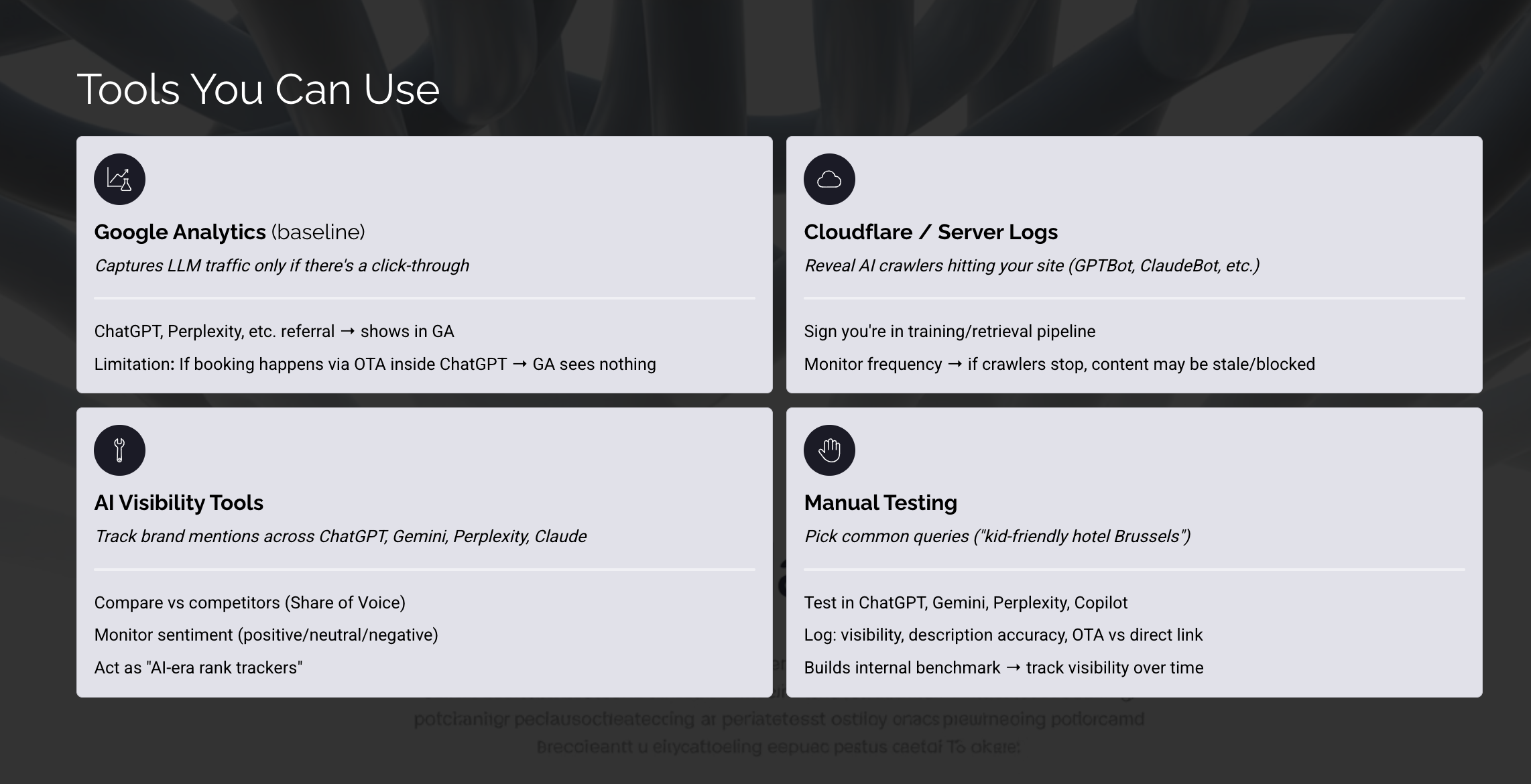
Run the fixed prompt sample; check material facts, citations, and critical errors; review analytics referrals as partial evidence only; review crawler activity where logs are available; resolve priority errors, source conflicts, and technical failures; record changes; and re-run failed checks. Monthly checks against a fixed query set are realistic for most properties; weekly testing is usually unnecessary unless something material changed.
Event-triggered review
Re-audit after a rebrand, renovation, material amenity or policy change, website or booking-engine migration, structured-data change, firewall or bot-management change, or major answer-surface change. Weekly testing is optional for active remediation, a major launch, or paid monitoring; it should not be the default requirement for every property.
XLSX
Reusable download · Answer-side · Card G
Answer-Side Audit Workbook
What it is
A repeatable workbook for profiles, truth set, approved prompts, raw runs, citations, classifications, complete professional run metadata, and remediation, with a plain-language field guide and an isolated end-to-end example.
When to use it
For repeated answer observations and reporting.
What you enter
Property or entity, approved prompts, declared scope and test conditions, raw answers, citations, facts, classifications, evidence references, source versions, and limitations.
What it produces
A complete answer-run record, classifications, citation evidence, stability inputs, limitations, and a remediation log.
Fifteen numbered measures, reported in four groups — never collapsed into a score
The page and workbook use the same measure numbers, 01–15. The workbook's KPI Crosswalk maps them to the separate 22-row source dictionary. A source “material error rate” is related to, but not interchangeable with, the published Critical Error Rate: the latter counts property-mention runs containing a tier-1 error. Preserve each definition and its denominator when reporting.
Measurement prerequisites
Manual testing can support a small baseline audit, but recurring or portfolio-level reporting requires a measurement system that can maintain a versioned prompt set, execute and organize repeated tests across declared AI surfaces, retain raw responses and citations, record complete run metadata, and export observations the hotel can independently verify. This guide does not endorse a provider.
Measurement protocol
The Answer-Side Audit Workbook provides the columns for the required run record. Every KPI observation must record:
the property or entity ID and traveler segment;
the exact prompt text, prompt ID, prompt family, and prompt-set version;
the query domain, comparison set or topic, and branded or non-branded status;
the AI surface, interface, product mode, entry surface, transition path, and model version where available;
the geography, language, market, time zone, account or login state, and personalization or location state;
the measurement-window start and end, run date, run schedule, planned run count, and repetition number within the run set;
the raw response, citations, evidence timestamp, screenshot or evidence reference, and classification evidence;
the eligibility rule applied, whether the run was valid, and any exclusion reason;
the truth-set version and source-precedence version used for accuracy checks;
whether classification was human or automated and, if automated, the method and classification-rules version; and
for repeated runs, whether the usable outcome matches the modal outcome for that controlled prompt group.
Test every language relevant to the declared guest markets; do not treat an English-language home-market result as representative of all markets.
Reporting principles
Report by engine and domain first. Show every core KPI by AI surface × query domain before any cross-engine or cross-domain aggregate. An average can hide the diagnostic disagreement the audit is meant to expose.
Never blend branded and non-branded prompts. Branded prompts naturally produce different presence and recommendation behavior from non-branded discovery prompts. Report them as separate populations.
Measurement realities
Reality
Zero-click is the default, not the exception
A hotelier may see almost no AI-referred traffic in web analytics and conclude AI visibility is not worth pursuing. That reading misses answers in which a property is described, compared, recommended, or misdescribed without anyone clicking through. Referral data measures the residue of AI-mediated discovery, not its volume.
Referral analytics are partial evidence only and never the primary measure. Observed answer behavior is the primary measure. Any KPI drawn from analytics must carry its limitation next to it.
Reality
Tool proliferation
Hoteliers are being approached by a growing number of AI visibility measurement tools, some of which operate by mass automated prompting. This guide names no measurement vendor and endorses none. Use the questions below to evaluate any method and require the underlying evidence rather than accepting a score alone.
Reality
Platform landscape
Prioritize universal principles over platform-specific optimization because different systems prioritize different data and platform-specific findings date quickly. Platform context belongs inside measurement, framed around where a property's traffic and mentions actually originate.
Reality
KPI discipline
Every metric carries its data source, known limitations, and where a hotelier can actually find it. A metric that cannot be located by the reader is a talking point, not an operational KPI.
Hotel Truth Set prerequisite
Accuracy Rate and Critical Error Rate require an owner-approved Hotel Truth Set maintained independently of the measurement system. Each fact should carry the canonical value, authoritative source, owner, materiality tier, effective date, last-verified date, and review cadence. Compare every observation with the truth-set version effective when the prompt was run.
Reporting rules
report by engine or surface and query domain before showing any aggregate;
keep branded and non-branded populations separate;
place the valid-run count and denominator next to every rate;
retain raw responses, citations, and classification evidence;
state whether classification was human or automated and how it was performed;
show the language, market, geography, date, run number, and time window;
do not impute citation data for a surface that does not expose citations; and
label referral and bot-traffic measures as diagnostics, not proof of AI-influenced bookings.
In the measurement workbook, declare one period × surface × domain × market × language × branded-status population on the Reporting Scope sheet and import only matching rows. The dashboard summarizes every imported row; ordinary Excel display filters do not recalculate it. Report authoritative and owned-source citation shares separately on Citation Detail before using the non-duplicative combined share.
Grouped KPI framework. Presence, accuracy, and recommendation are reported as separate outcome groups because they answer different questions and use different denominators. Reliability and traffic measures remain supporting diagnostics; no group is rolled into a composite score.
Important
Do not use a composite AI visibility score for cross-vendor comparison. Vendors can use different prompts, engines, weights, samples, data sources, and normalization methods; one provider's score is therefore not directly comparable with another's. Blending many measures also removes the diagnostic signal needed to choose a fix.
If one priority measure is required, use Recommendation Rate as the top-of-funnel signal and Critical Error Rate as the factual-integrity signal. Review them together: a high recommendation rate can be harmful when the recommendation rests on a material error.
Presence and coverage
Does the property appear across the declared prompt and intent population?
01
Observed Presence Rate
Core
valid runs where the property substantively appears ÷ total valid runs × 100
Numerator
Valid runs where the property substantively appears
Denominator
All valid runs
Eligibility
Use the declared prompt population; keep citation-only appearances separate.
Sample window
Declare exact dates; use 10–14 independent runs per prompt and surface across approximately 14 days for a professional baseline.
Surfaces / evidence
Report each tested AI surface, product mode, market, and language separately.
Prompt-set version
Required: record exact prompt text and prompt-set version.
Use
Establishes whether the property appears at all. Report per engine and query domain. It is meaningless without the disclosed denominator, run count, prompt population, and segmentation; citation-only appearances stay separate.
Limit
Meaningless without a disclosed denominator, run count, prompt population, segmentation, and raw observations.
Where found
Manual testing for a small baseline or a specialized measurement system at scale.
02
Intent Coverage
Core
tested applicable intent categories with qualifying inclusion ÷ total tested applicable intent categories × 100
Numerator
Applicable intent categories with qualifying inclusion
Denominator
All tested applicable intent categories
Eligibility
Declare the intent inventory, applicability, and exclusions before testing.
Sample window
Declare exact dates and repeated observations supporting each category.
Surfaces / evidence
Report each surface and segment separately.
Prompt-set version
Required: disclose the versioned intent and prompt set.
Use
Shows whether visibility extends across the traveler needs the hotel explicitly chose to serve. Declare the intent inventory and exclusion rules before testing; one strong generic query cannot establish broad coverage.
Limit
Depends on a declared, versioned intent inventory; exclusions and ineligible answers must remain visible.
Where found
The versioned prompt set and valid answer observations.
Accuracy and observable evidence
When the property appears, are material facts correct and is the exposed evidence appropriate, diverse, and governed?
Include only claims evaluated against the owner-approved Hotel Truth Set effective on the run date.
Sample window
Declare the answer-run dates and truth-set effective window.
Surfaces / evidence
Report each tested answer surface separately.
Prompt-set version
Required: record exact prompt and prompt-set version.
Use
Shows whether the hotel's appearance is factually reliable. It depends on a current, owner-approved Hotel Truth Set. Separately count omissions, unsupported claims, and false claims, and disclose truth-set currency.
Limit
Depends on a current, owner-approved Hotel Truth Set and disclosed truth-set currency.
Where found
Manual or specialized answer review plus the Hotel Truth Set.
04
Critical Error Rate
Core
runs mentioning the property that contain at least one tier-1 error ÷ total runs mentioning the property × 100
Numerator
Runs mentioning the property with at least one tier-1 error
Denominator
All runs mentioning the property
Eligibility
Apply a documented materiality rubric to included runs evaluated against the effective Hotel Truth Set.
Sample window
Declare the answer-run dates and truth-set effective window.
Surfaces / evidence
Report each tested answer surface separately.
Prompt-set version
Required: record exact prompt and prompt-set version.
Use
Prevents booking-, money-, accessibility-, safety-, cancellation-, or fee-related errors from being hidden inside a high overall accuracy average. One tier-1 error is enough to count the run; do not weight a run by the number of tier-1 errors.
Limit
Has the same truth-set dependency as Accuracy Rate; one tier-1 error is enough to count a run.
Where found
Manual or specialized answer review plus the Hotel Truth Set.
05
Citation Source Mix
Core
citations in source category ÷ total citations × 100
Numerator
Exposed citations in the source category
Denominator
All exposed citations classified
Eligibility
Use only surfaces that expose citations; keep source categories and support type visible.
Sample window
Declare the answer-run and citation collection window.
Surfaces / evidence
Report each citation-exposing surface separately.
Prompt-set version
Required: tie each citation to the exact prompt-set version.
Use
Shows whether answers rely on owned/brand or third-party sources and whether a citation supports a fact or a recommendation. Citations are an observable window, not proof of every source that influenced the model. Use only on surfaces that expose citations and flag cross-brand contamination.
Limit
Citations are an observable window, not a complete trace of every source that influenced an answer.
Where found
Manual citation review or a specialized measurement system.
06
Citation Source Breadth
Core
count of unique citing domains for the property, per topic and period
Numerator
Unique citing domains for the property
Denominator
Not applicable: this is a count; disclose the observed answer population and period
Eligibility
Count only exposed citations within the declared topic and observation set.
Sample window
Declare the exact collection period.
Surfaces / evidence
Report each citation-exposing surface and topic separately.
Prompt-set version
Required: tie the observation set to a prompt-set version.
Use
Describes how broad or fragile the observable corroborating source set is. A raw domain count does not establish authority, publisher independence, or causation. Treat correlations as observed, not proven.
Limit
A raw domain count does not establish authority, publisher independence, or causation.
Where found
Manual citation review or a specialized measurement system.
07
Citation Rate
Core
included answers with at least one exposed citation ÷ included answers on citation-exposing surfaces × 100
Numerator
Included answers with at least one exposed citation
Denominator
Included answers on surfaces that expose citations
Eligibility
Do not impute citations for surfaces that do not expose them.
Sample window
Declare the answer-run and citation collection window.
Surfaces / evidence
Report each citation-exposing surface and intent separately.
Prompt-set version
Required: record exact prompt and prompt-set version.
Use
Shows how often an observable inclusion is accompanied by exposed evidence. Do not impute citations on a surface that does not show them, and do not treat an exposed citation as a complete explanation of model behavior.
Limit
Applies only where citations are exposed and cannot reveal every source that influenced an answer.
Where found
The answer-run and citation logs.
08
Authoritative or Owned Citation Share
Core
unique citations classified as approved authoritative or owned ÷ all exposed citations classified × 100
Numerator
Unique citations classified as approved authoritative or owned
Denominator
All exposed citations classified
Eligibility
Apply a governed field-specific source classification; report owned and authoritative third-party sources separately and count a citation meeting both conditions only once in the combined share.
Sample window
Declare the citation collection window.
Surfaces / evidence
Report each citation-exposing surface and source class separately.
Prompt-set version
Required: tie citations to the exact prompt-set version.
Use
Shows whether observable evidence comes from sources the hotel recognizes as authoritative and correctable. Report owned and approved third-party sources separately before presenting the combined share.
Limit
Requires a governed source-classification list; a source can be authoritative without being owned, and ownership alone does not guarantee accuracy.
Where found
The citation log plus the hotel's approved source classification.
Recommendation and comparative placement
When recommendation is a legitimate outcome, is the hotel actively steered toward the traveler and where does it appear within the eligible response set?
09
Recommendation Rate
Core
valid runs classified Recommendation ÷ valid runs where recommendation is a legitimate outcome × 100
Numerator
Valid runs classified as Recommendation
Denominator
Valid runs where recommendation is a legitimate outcome
Eligibility
Exclude branded fact and policy prompts; use a worked recommendation rubric.
Sample window
Declare exact dates; use the professional repeated-run baseline for a rate.
Surfaces / evidence
Report each surface, intent family, market, and language separately.
Prompt-set version
Required: record exact prompt and prompt-set version.
Use
Separates active steering from neutral presence. Exclude branded fact and policy queries from the denominator; consistent classification requires a worked rubric.
Limit
Classification requires judgment and a worked rubric; branded fact and policy prompts do not belong in the denominator.
Where found
Manual testing or a specialized measurement system.
10
Recommendation Position
Diagnostic
sum of position values across recommended runs ÷ total recommended runs
Numerator
Sum of recorded position values
Denominator
All recommended runs with a genuinely ordered answer
Eligibility
Exclude unordered answers and disclose whether ordering was explicit or inferred.
Sample window
Declare the repeated-run window and the average answer field size.
Surfaces / evidence
Report each surface and prompt family separately.
Prompt-set version
Required: record exact prompt and prompt-set version.
Use
Shows where the property appears when it is actively recommended. Response order may not be an intentional ranking; report whether ordering was explicit or inferred and show the average field size.
Limit
Many answers are not genuinely ordered; position may reflect response structure rather than intentional ranking.
Where found
Manual testing or a specialized measurement system.
11
Recommendation Top-3 Rate
Core
recommendation-eligible runs where the property appears in the top three ÷ recommendation-eligible runs where the answer contains more than three options × 100
Numerator
Recommendation-eligible runs with the property in the top three
Denominator
Recommendation-eligible runs whose answer contains more than three ordered options
Eligibility
Exclude unordered answers and answers with three or fewer options.
Sample window
Declare exact dates and the repeated-run schedule.
Surfaces / evidence
Report each surface, intent family, market, and language separately.
Prompt-set version
Required: record exact prompt and prompt-set version.
Use
Distinguishes early recommendation from an appearance deep in a longer answer. It is not applicable to unordered answers or answers with three or fewer options; disclose field size.
Limit
Not applicable to unordered answers or answers with three or fewer options; disclose field size.
Where found
Manual testing or a specialized measurement system.
12
Share of Recommendation
Core
property recommendations for topic X ÷ total recommendations across all properties for topic X × 100
Numerator
Property recommendations for the declared topic
Denominator
All recommendations across the declared property set for that topic
Eligibility
Declare the topic, competitor set, and inclusion rules before testing.
Sample window
Declare exact dates and use a comparable repeated sample.
Surfaces / evidence
Report each surface and topic separately.
Prompt-set version
Required: record exact prompt and prompt-set version.
Use
Adds competitive context without imposing an unsupported benchmark. The relevant competitor set can differ by topic. Report raw share; do not create a fair-share index until an intent-specific comp-set method is approved.
Limit
The relevant competitive set differs by topic; do not impose a fair-share benchmark without an approved method.
Where found
Manual testing or a specialized measurement system.
Reliability and traffic context
These measures help interpret variability and observable traffic mechanics; they do not replace the three outcome groups above
13
Run-to-Run Stability
Diagnostic
repeat runs matching the modal outcome ÷ total repeat runs for that prompt × 100
Numerator
Repeat runs matching the modal outcome
Denominator
All repeat runs for the same prompt configuration
Eligibility
Hold prompt, surface, locale, account state, and time window as constant as practical.
Sample window
Declare the repeated-run window and schedule.
Surfaces / evidence
Report every surface and product mode separately.
Prompt-set version
Required: use one unchanged prompt-set version for the run set.
Use
Shows whether one run is representative enough to interpret. Hold the prompt, engine, locale, and time window constant. This measures reliability, not hotel performance, and requires repeated runs and a defined outcome.
Limit
Requires repeated runs under controlled conditions and measures reliability, not hotel performance.
Where found
Repeated manual tests or a specialized measurement system.
14
Referral Traffic
Diagnostic
AI-identifiable sessions from AI engines ÷ total direct-channel sessions
Numerator
AI-identifiable sessions from declared AI referrers
Denominator
All direct-channel sessions in the same reporting window
Eligibility
Use documented referrer classification and retain unclassified traffic separately.
Sample window
Declare the web-analytics reporting window.
Surfaces / evidence
Web analytics; identify included referrers and owned channels.
Prompt-set version
Not applicable to traffic collection; disclose any prompt test used for comparison separately.
Use
Measures identifiable clicks, not the full influence of zero-click answers and not OTA-side traffic. It should never be the primary visibility KPI.
Limit
Captures identifiable clicks only; it misses zero-click influence, direct URL entry, and OTA-side traffic.
Where found
The property's web analytics, with manual segmentation where required.
15
Bot Traffic
Diagnostic
count of AI-identified crawler sessions per period, segmented by bot identity
Numerator
AI-identified crawler sessions
Denominator
Not applicable: this is a count; disclose the log population and period
Eligibility
Use declared bot identities in raw server or CDN logs.
Sample window
Declare the server-log reporting window.
Surfaces / evidence
Server or CDN logs; segment by bot identity.
Prompt-set version
Not applicable.
Use
Use raw server or CDN-level logs rather than standard web analytics that may filter bots. Zero identifiable bot traffic does not prove an engine has no knowledge of the hotel; models may use licensed, cached, or third-party sources.
Limit
Not all engines use identifiable crawlers; zero crawler traffic does not prove the engine lacks knowledge of the hotel.
Where found
Raw server or CDN-level logs.
Operational diagnostics. Run-to-Run Stability, Referral Traffic, and Bot Traffic are used as diagnostics. They explain the reliability or observable mechanics around the core outcomes; they are not substitutes for presence, accuracy, critical errors, recommendation, or citation measures.
Deliberately outside the current release
Observed change / lift: descriptive trend can be shown after two comparable periods, but do not claim causal lift without a valid design. Deferred until pilots establish baselines.
Positioning Alignment Rate: keep the qualitative representation review; defer a formal rate until a repeatable rubric exists.
Fair-Share Index: replaced by raw Share of Recommendation until an intent-specific competitor benchmark is approved.
Useful Path / Booking Path Conversion: not included because current measurement is not sufficiently reliable; reconsider only when a future method supports it.
XLSX
Reusable download · Measurement
Full KPI Dictionary & Measurement Workbook
What it is
All 22 source-dictionary rows, a crosswalk to the 15 numbered measures on this page, one declared reporting scope, imported observations, diagnostic inputs, citation detail, formula-driven results, a plain-language field guide, and an isolated formula-driven example.
When to use it
After answer-side observations have been collected and validated.
What you enter
Scope-matched valid runs, citations, truth-set checks, intent coverage, referral and bot inputs, prompt versions, exclusions, and limitations.
What it produces
A complete KPI dictionary and denominator-aware reporting with an auditable, non-composite evidence trail.
Do not publish a KPI row until every required disclosure field is complete. Never blend foundational readiness with observed visibility.
Fix the source, preserve before-and-after evidence, and re-test the same condition
6.1 Answer-side routing
Route the remediation according to the failed outcome. Do not prescribe a technical fix for a relevance problem or a content rewrite for a sampling problem.
Symptom
Low presence
Likely cause: Relevance and source coverage
Next action. Review profile relevance, entity and source coverage, content depth, and site-side readiness.
Symptom
Low accuracy or high critical errors
Likely cause: Truth and conflicts
Next action. Correct the truth source, conflicting profiles, and cited pages.
Symptom
Low recommendation
Likely cause: Intent and differentiation
Next action. Review intent relevance, uniqueness evidence, value-proposition capture, and positioning.
Symptom
Weak citation mix or breadth
Likely cause: Corroboration and source gaps
Next action. Strengthen accurate corroboration and address source gaps.
Symptom
Unstable results
Likely cause: Sampling discipline
Next action. Increase repeats, narrow the time window, and avoid acting on a single run.
6.2 Site-side routing
Auto — a repeatable automated check or fix where appropriate;
Agency — markup, rendering, navigation, server behavior, and website implementation;
Content — facts, policies, attributes, page depth, evidence, and guest-question coverage; and
Config — crawler policy, WAF or CDN behavior, hosting, environments, and access decisions.
Property teams on a brand domain should still run the technical audit. Findings they cannot fix become a specific evidence pack for the brand or agency rather than an undifferentiated report.
Questions for the brand and vendor
Property to brand
Ask who owns the change
Which crawl, rendering, schema, content, multilingual, and shared-profile findings can the property change? Which require a corporate owner? What evidence and service level will the brand provide?
Hotel to vendor or agency
Require exportable evidence
Require the prompts, engines, markets, languages, run counts, truth-set versions, raw answers, citations, exclusions, formulas, limitations, owners, and re-test method.
Contributors
People whose substantive inputs shaped this guide
Adam Hert
Chief Product Officer
Operto
Mandatory guest-profile and property-uniqueness sequence, realistic niche targeting, prompt selection, competitor testing, and the warning against over-general targeting.
Benoit Hediard
Founder
Globetrotters.ai
The 18-check foundational-readiness contribution, the public outside-in versus owner-assisted distinction, inclusion rules, and sampling considerations.
Benu Aggarwal
President and Founder
Milestone
Visibility beyond ranking, the entity-authority model, six-stage lifecycle, decision-layer framing, answer-unit method, entity relationship concepts, the need to treat discoverable hotel images as maintained assets, and the nine practical principles in Things you should never do.
Brian Gauthier
VP of Product Management
Curacity
KPI framework, Hotel Truth Set, formulas, denominators, run metadata, per-engine and per-domain reporting, referral and bot diagnostics, and presence-versus-recommendation separation.
Christina Leme
Senior Director, Global Media
Cendyn
Progressive complexity, accessibility for operators, and the diagnostic-matrix concept used to connect symptoms, evidence, likely causes, and next actions.
Daniel Hersey
Founder & CEO
Caleta
Prioritization of data lineage before room schema, plus complete controlled-value definitions for hotel entities and room data.
Donna Rougeau
Founder & Chief Architect
Protected by ALFIE
Data-state taxonomy, source-attribution standards, data-lineage controls, a forensic hotel example, citation-exposure prioritization, and Free Booking Links as an action-readiness example.
Duy Nguyen
Founder & CEO
Rebean.ai
Site-side and answer-side separation; evidence tiers; four result states; evidence records; remediation routes; query classes; repeat-run discipline; and the 26-check technical readiness checklist.
Ira Vouk
Founder
AI Hospitality Alliance
Workgroup direction and reconciliation; the guest-first sequence decision; separation of site-side and answer-side audits; KPI disclaimer; publication structure; the Hotel Content Mapper workflow; and practical image and video creation, accessibility, metadata, delivery, and maintenance guidance adapted into the companion checklists.
Jaffrey Ali
Chief Product Officer
Hapi
Lineage field requirements, capture-now data controls, the seven-entity hospitality minimum, and a structured 25-question self-assessment contribution.
Lennart Reents
AI Product Lead
Apaleo
The API-first Storefront and MCP example showing how AI discovery can hand off to availability and booking tools through a hotel website, resource registry, or connector store; used to clarify the boundary between measured visibility and transaction execution.
Lynn Patchett
Founder
Kollective
The observed-answer method; branded-versus-discovery discipline; full prompt-angle and placeholder libraries; brand and loyalty cautions; six core prompt forms; controlled test conditions; engine priorities; repeated sampling; five per-engine rates; fact-accuracy spot-check; and the formula-linked self-assessment workbook architecture. Also supplied a completed discovery-prompt example and optional hotel/room schema-generation and crawler-access tools.
Nick Slavin
CEO & Co-Founder
Curacity
The three-stage distinction between eligibility and visibility, recommendation, and transaction; separate KPI treatment for each; prioritization of critical measures for resource-constrained teams; and the implementer-versus-commercial-owner audience split.
Safa Rahal
Cluster Director of Marketing & Communications
Accor
Accuracy labels, representation dimensions, cross-surface and cross-market review, third-party analysis, and the correction and re-test loop.
Sam Weston
Head of AI & Marketing
80 DAYS
Clarity, Consistency, and Credibility; content depth; source consistency; freshness ownership; entity credibility; third-party authority; evidence-backed claims; SEO/AEO framing; zero-click measurement reality; and the brand/vendor question structure.
Tom Teta
Chief Data & Transformation Officer
Cendyn
Organization and property identifier schema, DUNS strategy, and regional identifier standards for cross-system entity resolution.
Official guidance for descriptive filenames, alt text, relevant surrounding text, responsive delivery, and image discovery. Accessed September 13, 2026. Google-specific guidance, not a guarantee of AI recommendation.
Official guidance for video discovery, stable media and thumbnail URLs, watch pages, and metadata. Accessed September 13, 2026. Eligibility does not guarantee a search feature or AI recommendation.
Optional third-party tool for drafting structured markup. Inclusion is not an endorsement; verify every fact and validate output against visible content. Source record accessed August 28, 2026; no generated output independently validated for this guide.
Optional contributor-supplied third-party tool for drafting hotel and room markup. Review all facts and amenity settings before use; it complements the schema workbook rather than replacing validation. Tool documentation accessed September 10, 2026; generated output not independently tested.
Optional contributor-supplied third-party diagnostic for robots.txt, possible access blocks, and initial HTML. User-agent simulation does not verify genuine crawler access or answer visibility. Tool documentation accessed September 10, 2026; no property scan independently tested.