Identify the entities
Name the real business objects the records describe.


WORKGROUP 4 OUTPUT
How to turn fragmented hotel data into identifiable, traceable, quality-controlled records that AI systems can use and people can explain.
Includes free, reusable tools for each repeatable part of the workflow.
AI HOSPITALITY ALLIANCE
Start with one property · Room + Room Type
Systems + property information
Entities + relationships
Evidence
Quality checks
Traceable records for a defined AI use
Named owners·Preserved sources·Lineage
Hospitality teams often use different terms for the same kind of thing. One system may say “room,” another “suite,” and another “penthouse,” while each may attach the term to a sellable category, a physical unit, or a marketing description. The goal is not to force every source system to use identical words. It is to preserve each source term while mapping it to a shared entity, meaning, and relationship so that every system can interpret it consistently.
Hospitality data is usually distributed across property-management, reservation, customer, content, distribution, revenue, service, and other systems. The same organization, property, Room Type, Room, guest, or reservation may have different identifiers and values in each system. A value can be present and still be unsafe to use because its owner, age, source, meaning, or relationship to another record is unclear.
Business data alone is not enough. A usable foundation connects business data such as organizations, properties, and products; customer data such as guests and contact points; operational data such as stays, room status, and service activity; and performance data used to understand outcomes. Entity mapping establishes what each record describes. Context alignment shows how those records relate and which functions depend on them. Together, they reduce repeated reconciliation between teams and help an agent map a user’s intent to the correct internal data and operation.
This guide gives hotel operators and technical implementers one sequence for turning those records into a reusable foundation. It answers three questions: What data must exist? Which relationships must be explicit? What must be checked before a record is used? It then provides the keys, data states, lineage fields, cleaning workflow, quality-rule types, operating measures, and reusable files needed to apply that sequence.
For a broader assessment of your hotel’s operational and digital readiness, use the AI Readiness Guide for Hotels →. This guide focuses specifically on preparing and maintaining the data your AI use cases depend on. Its data-foundation check tests the controls described here; it does not repeat the broader guide’s hotel-wide assessment or scoring.
The downloads are reference specifications and working templates, not a certified standard or a ready-to-run validation system. Start with the focused Room pilot and its dictionaries; use the broader inventories to select later extensions. Some implementation details still need agreement, as listed in Scope and limitations. Do not treat a populated example or a parsed JSON file as proof of conformance.
Entity-first sequence
Use this sequence before choosing a technical representation or exposing it for downstream use.
Name the real business objects the records describe.
Map different source terms to shared meanings while retaining the original values.
Show how the entities connect and what each connection supports.
Bring connected entities together without collapsing distinct identities or roles.
Extend the same language, keys, relationships, and controls to additional domains.
Read the numbered steps in order for a new implementation. Start with one property and the Room/Room Type example so the boundary is understandable. Preserve the exact source records, map them into a canonical shape, record evidence and trust state, apply the quality gate, and produce one current foundation record for each stable entity key. Once the result can be traced and reproduced, extend the same controls to the other six data domains.
The outcome is not a single database product or public-web vocabulary. It is a versioned operating method: each material fact can be traced to a source record; each important relationship is explicit; each current value has a state; and each promotion decision can be explained. Semantic layers, knowledge graphs, retrieval systems, structured markup, and AI applications can then consume that foundation without redefining basic identity and quality controls for every use case.
AWS describes a strong data foundation as use-case-led, connected, context-rich, owned, observable, and adaptable. In this guide, that perspective is applied through named owners, freshness expectations, known limitations, feedback routing, and product-health monitoring. It does not replace the hospitality entity model, the five record-level rule types, or the names of the three layers used here.
Define the business meaning, entity, field, and original value.
Name the source owner and the person or team responsible for conflicts.
Set the freshness expectation for the specific use.
Record known gaps, coverage limits, and unresolved dependencies.
Name the decisions, workflows, and AI uses that consume it.
Result
Every entity can be identified. Every material relationship is explicit. Every material fact carries a state and evidence that communicate how far it can be trusted.
Begin with one property, one Room Type, one physical Room, the source systems that describe them, and one intended use. Room is useful as the first test because it is more atomic than Guest or Reservation and exposes a common modeling error: a sellable Room Type is not the same entity as an individual physical Room.
Lineage
Lineage documents what happened to any field: which entity it belongs to, where it came from, what evidence was compared, who or what acted, when it happened, and which state resulted.
Room / Room Type
Room and Room Type are the bounded entities used to prove that the lineage, identity, relationship, state, and quality controls work together. “Lineage plus Room” means applying the evidence method to this first subject – not treating lineage as part of the Room entity.
| Step | Action | What to do | Output |
|---|---|---|---|
| 01 | Set the boundary | Name the property, Room Type, Room, source systems, intended use, and owners. | Scope |
| 02 | Inventory the source records | Capture source keys, timestamps, original values, and known overlaps or contradictions. | Source register |
| 03 | Map the entities and fields | Separate Property, Room Type, and Room; preserve source values while producing the canonical shape. | Conformed records |
| 04 | Apply state, lineage, and rules | Compare evidence, classify each material fact, and run the quality gate. | Quality evidence |
| 05 | Promote and explain | Create the current foundation output only when the record meets the configured outcome. | Foundation record |
A guest may ask whether a tall vehicle will fit in the garage, whether the pool is heated in November, or whether early check-in is possible after a ferry arrival. These questions may need information that is not recorded in a PMS field. Missing structure must not become permission for an agent to invent an answer.
When inventorying sources, distinguish system registers – records maintained in the PMS, CRS or POS – from curated property-fact and policy registers, meaning maintained collections of information supplied by the hotel. Give curated information a named owner, retain its versions, and tag it with the relevant stay phase. Keep the applicable policy separate from the current system state or staff decision needed to fulfil a particular request.
An agent may explain the recorded policy and log a discretionary request. It must not guarantee that request without confirmation from the current system state or staff approval. A documented policy alone is not a promise that the request can be fulfilled for this guest.
Check the behaviour: ask the agent for a guaranteed 10am check-in. With no system confirmation or staff approval, it should log the request and make clear that 10am check-in is not guaranteed. This is an operating check, not an additional machine-readable fixture or a new policy schema.
Landed, Conformed, and Foundation keep raw evidence, record-level history, and current usable records separate. Promotion between them is controlled so that cleaning does not erase the source and every downstream use does not have to repeat identity resolution and basic quality work.
Source fidelity
Source payloads exactly as received, separated by source, with arrival time and a durable reference. Failed records and reruns remain traceable.
Canonical shape
One row per record version, shaped by entity. Original values and history remain intact; keys and relationships are resolved where possible.
Current data product
One current row per entity key, with resolved relationships, data state, lineage, and a quality-gate result. CONFLICTING and DEPRECATED records remain outside this layer.
AWS uses the common medallion terms bronze, silver, and gold. Bronze resembles Landed, and silver resembles Conformed. Gold is usually use-case-specific or aggregated; it is not the same as the Foundation defined here, which is a reusable current record designed to support multiple uses.
These seven domains are the minimum entity set needed to support meaningful hospitality questions across systems. They are not a complete inventory of every record a hotel may manage. Use the larger candidate workbook when a use case requires additional entities, but do not expand the model until each added entity has a purpose, owner, key, relationships, and control fields.
The wider reference inventory contains 58 internal and 40 digital entities. Its crosswalk has 21 distinct mapped digital targets and 24 structural/discovery entries, with five appearing in both lists: 21 + 24 − 5 = 40. The lists describe overlapping roles, not separate catalogues. LocationFeatureSpecification via hasAmenityFeature is a nested feature structure, not an additional catalogue entity. The five ldb: concepts are candidate extensions, not standard vocabulary. Validate them for the intended implementation.
The business role behind the hotel, such as a brand, management company, ownership group, franchisee, or independent operator. It remains distinct from the physical property.
The operating hotel, its identifiers, its relationship to one or more organizations, and the tenancy boundary for property-level facts.
The sellable Room Type and the individual physical Room, modeled separately and linked with stable identifiers.
Rate plans and codes, property and Room Type binding, amount and currency, validity dates, policy, refundability, length-of-stay limits, source, state, and lineage.
The person, modeled independently of the booker, payer, loyalty member, or reservation. A dining, spa, event, or service activity may originate a Guest record even when no stay exists.
The booking, guest, property, Room Type and assigned Room relationships, scheduled and actual dates, status, cancellation, source, state, and lineage.
Concrete operational records such as service requests, housekeeping tasks, spa appointments, event bookings, and guest communications – not one catch-all activity table.
Common record shape
Assigned key, source-scoped keys, property/organization tenancy, and external identifier crosswalks where used.
The business attributes that describe the entity, with original values retained where normalization occurs.
Source of record, data state, lineage reference, schema version, freshness class, timestamps, and quality-gate outcome.
This is the target record shape, not a claim that every downloadable profile implements every control. The focused Property profile covers identity and tenancy; it is not a complete location model. The wider inventory contains location fields for selection. Contact Point, staff, policy, folio and other referenced entities are not all concrete profiles in the JSON bundle. The supplied Activity profiles cover housekeeping, service requests, spa, events and communications; no dining-transaction profile is supplied.
Focused and wider candidate profiles still differ in key types and lineage representation. Complete sample records, referenced profiles and an execution engine are not supplied. Do not connect the profiles without explicitly reconciling these differences.
Download JSON ↓This is a candidate inventory, not a universal canonical model. External vocabulary and graph classifications must be checked for the intended use.
Download XLSX ↓Reference workbook. Its appendices include broader working material, and its external vocabulary, identifier, accessibility, and mapping content must be verified before normative use.
Download XLSX ↓A hotel, the company that owns it, the company that manages it, and the brand it operates under are different entities. Systems often use different codes for each. The foundation therefore uses stable assigned keys for its own records and stores source-scoped or external identifiers in a crosswalk instead of treating any one external identifier as a universal master key.
A Property can be associated at the same time with an ownership group, management company, brand or franchisor, franchisee, or independent operating entity. Keep each Organization distinct and record the role it plays in relation to the Property; do not collapse these parties into one company record or assume the brand identifies the owner or operator. If the implementation uses one operating Organization as the primary tenancy link, preserve the other ownership, management, and brand associations as separate explicit relationships.
An identifier without its scheme, issuer, or source is ambiguous.
Organization and Property context travel with every key and fact.
Exact source keys and verified identifiers resolve records; name, address, or domain similarity produces a candidate for review.
Do not silently drop a value that cannot yet be mapped. Record the ambiguity and its age.
Capture at ingestion
Classify the fields
A fact about the entity, such as a Room Type occupancy limit.
A fact captured on an event, such as the rate booked on a reservation.
A reference to another entity, not a copied text value.
A calculated value with an explicit rule; do not store it as an unexplained entity fact.
A summary over records or time, kept separate from the current entity record.
Minimum relationships
Declare source precedence per attribute, not only per entity. Use the domain-owned or point-of-capture source where that is explicit, define a fallback, retain the losing values in history, and record every merge so it can be reversed. Probabilistic matching may propose a candidate; it must not silently become a resolved identity.
Keep three identifiers distinct: the assigned foundation key, the original source key together with its namespace, and any optional external identifier. A matching name, address, email, phone or domain proposes a candidate; it is not a final identity key. Do not duplicate a company to express different roles. The current single organization link does not encode every owner, manager and brand relationship; the reusable relationship structure and crosswalk representation still need to be agreed.
Before comparing values, align their meaning: physical room count, sellable inventory and currently available rooms are different facts. A source-precedence decision should identify the attribute, its meaning, authoritative source, fallback and resolution evidence. Rank alone must not erase a credible disagreement. Shared corporate ownership also does not grant cross-property access; declare the scope of each profile and validate references against the applicable boundaries.
External identifier corrections are documented in the reference workbook: IATA location codes identify transport locations, not a universal hotel ID; DUNS does not establish every owner or brand relationship; and tax/registry checks depend on jurisdiction and date. See the official identifier references before implementation.
No listed external identifier – including DUNS, LEI, IATA, OTA, benchmarking, GDS, tax, or registry identifiers – is a universal golden key. Coverage and operational claims require current verification before adoption.
Download XLSX ↓A value may look clean and still be old, unsupported, attached to the wrong entity, or contradicted by another source. The four data states communicate the evidence condition of the fact. The quality-gate outcome – pass, load with warning, or quarantine – communicates what the processing workflow does with the record. These are separate axes, and lineage supplies the evidence trail for actual state changes.
A material fact is one whose accuracy or uncertainty can change the answer, decision or action in the chosen use. Trust describes that fact; a gate controls use of the record. The current profiles expose a record-level data_state, while lineage identifies a field_path. The package does not yet define a complete field-state representation or a rule for combining field states into a record-level decision. Do not silently assume that all fields share the same evidence, or that every field conflict has the same business consequence.
A domain or enum failure changes the quality-gate outcome to warning or quarantine according to severity; it does not change data_state by itself. CONFLICTING is reserved for credible source disagreement or an ambiguous record match. A record can therefore be UNVERIFIED and quarantined at the same time.
Verification establishes whether a fact is supported by evidence. It does not establish availability for particular dates, permission to include it in an offer, or a commitment to deliver it. Those decisions depend on the relevant operational and commercial systems and any required approval. These are not additional data_state values; the four evidence states and quality-gate outcomes remain unchanged.
Verification must say what was checked. An authoritative source can verify a fact; two copies controlled by the same property are not independent corroboration. Absence from another source is not disagreement. Email delivery, opening or a click does not by itself prove personal-email ownership, and an OTA opt-in does not establish the hotel’s marketing permission. Trust state and an access_class label do not grant authorization.
Source attribution
A fact has one declared authoritative source of record at a time.
Every fact carries both source_type and a specific source_id.
A disagreement is recorded as a conflict rather than silently resolved.
Evidence points to an independently checkable URL, document, checksum, or record.
Open-web signals are evidence to compare, not automatic truth.
Minimum lineage entry
entry_identity_typeentity_idfield_pathactionactor_typeactor_iddata_statesource_typesource_idevidence_referencecompared_toconflict_referenceoccurred_atrecorded_atschema_versionpurposeaccess_classconfidence_methodPreserve original values and resolvable evidence when a value changes even if its state remains VERIFIED. The supplied materials describe both field events and state transitions; the exact event rule and before/after evidence representation still need reconciliation. A quality-only warning or failure is logged separately and must not be mistaken for a trust-state transition. Keep that gate result visible to consumers; a shared machine-readable gate-log structure has not yet been supplied.
Field lifecycle
guest.phoneA phone number can be captured as UNVERIFIED, become CONFLICTING when a second source supplies a different value, and later become VERIFIED after confirmation. Each transition is a new lineage event; the original values and evidence remain available.
Field lifecycle: domain failure (does not change state)
room_type.operational_statusA Room Type’s operational_status is captured from the PMS as CLOSED_FOR_RENOVATION, outside the approved enum of ACTIVE, INACTIVE, UNDER_RENOVATION, and DECOMMISSIONED. The domain rule fails and the record is quarantined with the reason “operational_status not in controlled vocabulary.” The field remains UNVERIFIED. No lineage entry is created because the state did not change; the quarantine is logged as a quality-gate event. After correction to UNDER_RENOVATION and successful validation, the normal UNVERIFIED-to-VERIFIED transition creates the lineage entry.
The workflow combines source preservation, identity, state, lineage, quality rules, resolution, and promotion. It applies to a batch pipeline, an API ingestion path, or a manual reconciliation process as long as the evidence and outcomes are retained.
Determine the entity type, organization/property tenancy, source system, source record identifier, capture time, and ingestion time. A record that cannot be placed cannot be reconciled safely.
Retain the source payload exactly as received with arrival time and a durable source reference. Keep failed records and reruns traceable.
Convert values to the canonical entity shape while retaining original codes, units, locale, currency, source history, and one row per record version.
Apply key-presence, referential, domain, temporal, and plausibility rules. Also check source/evidence fields and property tenancy.
Compare authoritative and corroborating sources using declared source precedence. Record the comparison instead of silently selecting a value.
Assign VERIFIED, UNVERIFIED, CONFLICTING, or DEPRECATED from the evidence condition. Create a lineage entry when the state changes; record a rule failure that leaves state unchanged in the quality-gate log instead.
Route ambiguous matches and conflicting facts to the named owner. Retain competing values and the rule or evidence used to resolve them.
Apply the configured outcome: pass, load with warning, or quarantine. Promotion creates the current foundation record without deleting conformed history.
Expose the versioned foundation view for the defined implementation use. Never expose a conflict as settled truth.
Measure freshness, warnings, quarantine volume and age, unresolved identifiers, source changes, and recurring conflicts on a declared cadence.
Mark a superseded fact DEPRECATED and preserve its lineage. Handle any separately applicable retention or deletion decision outside this data-cleaning workflow.
The record meets the configured requirements and can be promoted.
The record remains usable for the defined purpose while the issue is recorded and counted.
The record is held back with a named owner, review cadence, reason, and age.
There is one current row per entity key; rerunning the same input is idempotent; the latest eligible record wins; and any tie is resolved by a declared rule. The conformed history remains available.
Never fill an unknown descriptive fact with a guess to satisfy a required field. Preserve the source and hold it for the configured review path when the selected profile cannot represent it. The package still needs an explicit distinction between unknown, absent and not applicable, and an agreed ordering/freshness control structure. A DEPRECATED parent may remain valid for a historical record even though it is not eligible for new current use.
A Room Type describes what can be sold; a Room identifies the physical unit that may later be assigned. Mixing them produces duplicate inventory, incorrect accessibility or amenity claims, and unreliable downstream answers. The pilot demonstrates the distinction and applies shared lineage and quality controls to both entities.
A physical Room retains its identity when its commercial classification changes. The pilot’s Room Type relationship records its inventory grouping; it is not the Room’s identity. More complex configurations require explicit mappings and relationship history beyond this pilot.
Sellable category
room_type_id – stable keyproperty_id – property bindingname – guest-facing canonical namecategory – required controlled room-type categoryoccupancy_max – maximum adult occupancyaccessibility_features – controlled accessibility references such as roll-in shower, hearing accessibility, visual alarm, grab bars, and lowered fixturesverification_method – required when accessibility features are presentamenities – controlled amenity references such as bed configuration, view, balcony, kitchenette, minibar, soaking tub, and fireplacemarketing_content – localized descriptions, photos, and language variantsoperational_status – operational status; not proof of availability for particular dates or a commercial commitmentsource_of_record – authoritative source referencedata_state – current evidence conditionlineage_entries – material field-level change referencesPhysical unit
room_id – stable keyproperty_id – property bindingroom_type_id – required relationshipunit_label – internal unit labelfloor_or_zone – floor or zoneoperational_status – physical operational statusaccessibility_features – unit-level accessibility exceptions or additionsverification_method – required when accessibility features are presentsource_of_record – authoritative source referencedata_state – current evidence conditionlineage_entries – material field-level change referencesAccessibility facts
The Room and Room Type accessibility_features field references a shared dictionary rather than free text. The current enum contains WHEELCHAIR_ACCESSIBLE_ROOM, WHEELCHAIR_ACCESSIBLE_BATH, ROLL_IN_SHOWER, GRAB_BARS, LOWERED_FIXTURES, HEARING_ACCESSIBLE, and VISUAL_ALARM. Keep specific claims separate – for example, do not collapse ROLL_IN_SHOWER into the broader WHEELCHAIR_ACCESSIBLE_BATH value.
When accessibility features are present, record verification_method as SELF_REPORTED, THIRD_PARTY_AUDITED, or ADA_SURVEY_ON_FILE. The dictionary also flags SERVICE_ANIMAL_ACCOMMODATING as a proposed addition, not an approved current enum value, and distinguishes it from a general pet-friendly policy. The cited compliance references are descriptive prompts; verify the applicable local requirements before normative use.
Digital accessibility attributes
The digital AccessibilityFeature reference adds four attributes. hasCategory classifies a feature as MOBILITY, HEARING, VISION, COGNITIVE, POLICY or GOVERNANCE. VISION and COGNITIVE extend category coverage; they do not invent new approved Room/RoomType feature values. hasBookingCriticality records BLOCKING, STRONG_PREFERENCE or NICE_TO_HAVE, so booking logic can distinguish a necessary feature from a preference.
hasDimensions holds quantitative evidence for the claim. Supplied measurements are examples, not legal thresholds. hasNamespacedId identifies the feature in a named namespace so systems can link the same concept instead of deduplicating by label. The namespace example is illustrative, not a declaration of an approved standard namespace.
Use these attributes in the digital feature reference, alongside the Room/RoomType accessibility values and their conditional verification_method. They are not four additional mandatory Room/RoomType fields. The Expanded Digital Entity Schema ↓, Candidate Entity Inventory ↓ and Master Workbook ↓ contain the attribute definitions and examples.
Entity boundary
A Property amenity is not automatically a Room amenity. Room Type marketing content is not an individual Room fact. An Organization identifier does not automatically identify a Property. Preserve the entity that owns the fact and the evidence behind it.
For booking-critical accessibility, verify the specific feature and its evidence rather than relying on a generic category. One verification method for a list does not describe different evidence for each feature, and an additions-only Room list cannot represent absence or override of a Room Type claim. Per-feature evidence and inheritance rules still need agreement. No new feature values or measurements are implied by the VISION and COGNITIVE categories.
EN 301 549 concerns ICT accessibility, not physical-room construction. SERVICE_ANIMAL_ACCOMMODATING remains a proposed policy topic, not an approved room-eligibility filter. For example, US Department of Justice guidance says guests with service animals must have the same opportunity to reserve available rooms. Check the applicable jurisdiction; see accessibility references.
Keep the internal foundation model separate from Schema.org. HotelRoom can describe a physical hotel room; this does not require publishing internal unit labels. The pilot’s occupancy_max is adult-only, whereas Schema.org occupancy counts all persons, including infants, so it is not an exact mapping. Use identifier or PropertyValue for raw identifiers; sameAs takes an identity-reference URL. Physical accessibility uses amenityFeature and LocationFeatureSpecification; accessibilityFeature describes CreativeWork. Labels such as hasName are candidate graph predicates, not automatically Schema.org properties. Select the appropriate LodgingBusiness subtype rather than mapping every property to Hotel.
The initial pilot covers physical Rooms and sellable Room Types. Preserve original source codes; pseudo rooms, shared/component inventory and run-of-house allocations need additional mapping before they can be counted as physical rooms. Distinguish when a status was observed or ingested from when a planned closure takes effect. A future effective date is not automatically a future observation error. Use date and timezone context or an explicit convention for overnight periods; do not assume every reversed time is valid.
What to extend next
After the Room pilot, extend the same controls to Organization and Property identity and location, then to Rate/Product records needed to support availability, rate, and the canonical direct-booking link. Use the intended AI question to set the order of later domains.
The accessibility and Schema.org tabs are descriptive references. Validate applicable accessibility requirements and current Schema.org definitions before using them as normative requirements.
Download XLSX ↓During the Room pilot, an external search can reveal a property-level fact that affects the surrounding inventory context – for example, a stated room count. This does not make the claim verified. The example below shows how discovery, entity mapping, comparison, validation, and lineage fit together.
The open-web view lists eight discovered signals for the Georgian Court Hotel. Preserve the claim, source URL or reference, time of discovery, and search context. A search result is evidence to compare – not automatically the source of truth.
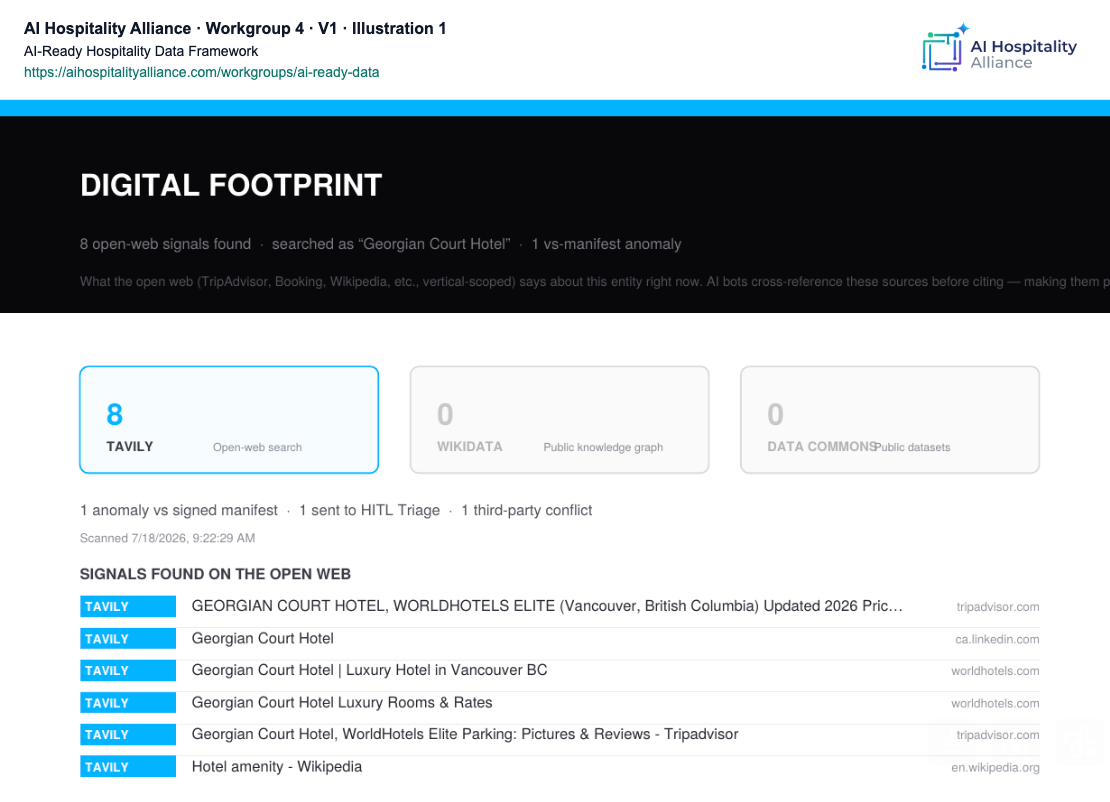
The source illustration maps schema:numberOfRooms = 180 on the Property record, defines the validation check, records the evidence reference, and shows the downstream usefulness of a resolved fact. If authoritative and corroborating sources agree, the fact may become VERIFIED. If credible sources disagree, it becomes CONFLICTING until the named owner resolves it.
| Entity | Property: Georgian Court Hotel |
|---|---|
| Mapped fact | schema:numberOfRooms = 180 |
| Evidence and validation | Preserve the source reference and compare authoritative and corroborating sources. |
| State decision | If sources agree, the fact may become VERIFIED. If credible sources disagree, it becomes CONFLICTING until the named owner resolves it. |
| Lineage | Record the evidence reference, comparison and resulting state. |
| Context debt and potential value | Describe the operational effect of missing or ambiguous context; they are not additional trust states. |
These screenshots are explanatory illustrations. The underlying structured input records, comparison results, and expected output were not supplied, so this example is not a conformance test fixture. If those records become available, the same sequence can be packaged as a reusable pilot-results test.
The “EU AI Act: Pass” label in the original illustration is not a compliance assessment endorsed by this guide. Eight search signals are not necessarily eight independent sources. Missing information on one site alone does not establish a conflict.
A quality rule is not only a written expectation. It has a stable identifier, the entity and target fields, one of five core rule types, a declarative pass expression, severity, the action on failure, a version, and an active status. A failed rule creates a quality-gate log entry. It creates a lineage entry only when the field’s data state changes. The operating process also needs an owner, a warning and quarantine path, a review cadence, and measurements that show whether the data product remains healthy.
The identifiers needed to place the record exist.
Property identifier, entity identifier, and source identifier are present.Usually quarantineEvery reference resolves within the declared tenancy and use context.
The Room Type belongs to its Property; historical references remain distinguishable from current eligibility.Usually quarantineControlled vocabularies are respected.
Operational status is one of the permitted values.Quarantine or warningDates and events are internally coherent.
Arrival is not after departure. Link an activity to its appropriate parent; not every activity occurs during a stay.Usually quarantineValues fall within a credible range rather than being merely possible.
Nights, occupancy, and rate are within the expected bounds defined for the use.Usually warningRule configuration
rule_identitytarget_fieldsrule_typepass_expressionseverityaction_on_failversionactiveRecord-level rules
The five rule types determine whether a record passes, loads with a warning, or is quarantined.
Product health
Track completeness, accuracy, timeliness, and consistency, along with missing-value spikes, anomalies, source drift, and recurring conflicts.
Ownership
Assign the owner, freshness expectation, severity, response path, quarantine review cadence, known limitation, and feedback route.
Conformance measures
Define freshness limits, warning treatment, quarantine age, review cadence, and promotion gates for the use case and operating segment. The material does not support universal numeric thresholds. The explicit exception is cross-tenancy leakage, where the acceptable target is zero.
The eight supplied conditions cover the Room Type pilot, not every entity. They require translation into a validation engine; severity determines WARNING versus QUARANTINE. The STANDARD occupancy limit of six belongs to Fixture 4 only, not a universal hotel rule. The rules can warn on an unapproved accessibility candidate, but the strict schema enum rejects that candidate: agree the ingestion-versus-promotion profile before combining those checks. Do not silently approve the value or remove the enum. Configure date-time validation explicitly; a format annotation alone is not guaranteed to reject invalid timestamps.
This convenience format shares the limitations of the standalone downloads. It is not an executable validator, complete test dataset or certification. If you only need one domain, the individual file will be lighter to work with.
Download XLSX ↓An SMB or independent property may begin with a smaller source set and combine responsibilities. An enterprise may operate shared rules, identifiers, and conformance reporting centrally while property teams remain responsible for local source meaning and issue resolution. The scale differs; the evidence requirements do not.
Property / SMB path
Corporate / enterprise path
Technology provider / integrator
Evidence expected from every path
For AI consumers, a source reference identifies where text came from; it does not turn that text into an instruction. Treat external descriptions and messages as untrusted data, and enforce action authorization separately. This is a consumption safeguard, not an AI-security certification. See OWASP prompt-injection guidance.
Maturity path
Records are source-bound and identities are not controlled.
Stable entity keys and source keys are defined.
Required relationships and identity-resolution rules are explicit.
State, lineage, survivorship, rules, warnings, and quarantine are operated.
A current, reproducible foundation output is available for the defined use.
The self-assessment groups 24 operational yes/no questions around the same three requirements as the foundation: nine questions about the data and identifiers that must exist, eight about relationships and resolution rules, and seven about the quality gate and repeatable operation. Record evidence for each answer; the workbook does not create an unsupported aggregate score.
Use these questions to check the data controls in your implementation, not to rate the hotel’s overall AI readiness. For the broader operational and digital assessment, use the AI Readiness Guide for Hotels →. Keep its assessment and results separate from this evidence-based data checklist.
Entities and owners, controlled primary keys, tenancy binding, source-system keys, external identifiers, source references, separate capture and ingestion time, original values, and one-to-many contact points.
Organization/Property separation, Room Type/Room separation, attribute classification, derived-value rules, explicit identity rules, held ambiguous matches, reversible merges, and source precedence.
Versioned rule configuration, critical failures held back, diagnosable quarantine, named review ownership, oldest unresolved age, idempotent reprocessing, and protection from older records overwriting newer ones.
The consent-by-channel-and-type question is a separate governance handoff, not one of the 24 operational assessment requirements. Privacy and permitted-use decisions remain outside scope. Use Yes/No answers with evidence, an owner and follow-up; do not calculate a composite score.
Support maturity descriptions with the mapped keys, fact-state evidence, lineage records and observed gate outcomes – not only completed cells. This checklist is a gap-finding tool, not a certification or an automatic maturity award.
Use the Readiness and Data Quality Workbook ↓ to answer the questions and record evidence.
Recommended implementation check
Select a small export from one property and one source system. Map its identifiers and fields, run the rules, compare expected and actual outcomes, review warnings and quarantined records, and record what changed. Repeat with a second source only after the first record can be explained from the source payload to the foundation output.
The guide supplies a data-foundation method and reusable implementation materials. It does not replace organization-specific decisions or the authoritative sources that govern a jurisdiction, vendor, property type, or technical environment.
The wider Rate/Product and Reservation/Stay references are not a complete dated-price, stay-night, availability or revenue model. Do not infer ADR/RevPAR, remaining availability or pickup from them without an agreed grain, formula, dates and source basis. Historical bookings must retain the terms accepted at booking rather than inheriting today’s cancellation policy. Candidate amounts need currency-appropriate precision; commissions need their applicable basis and period. Ratings require scale, source and time context before comparison. Country and nationality are not interchangeable. These boundaries do not add new commercial profiles to the Room pilot.
Privacy and permitted-use decisions are outside this guide. Apply the organization’s governance, contractual, and legal processes separately.
Define operational thresholds for the actual use and segment. This guide names what to measure but does not prescribe unsupported universal numbers.
The identifier workbook is informative. Verify coverage, format, issuer, hierarchy, access, licensing, and suitability before adoption.
The accessibility and Schema.org mappings are descriptive references. Check current authoritative requirements and definitions before normative use.
The four supplied Room Type fixtures cover a clean PASS, a plausibility WARNING with state unchanged, a domain-failure QUARANTINE with state unchanged, and a genuine source conflict that becomes CONFLICTING and is QUARANTINED. These are behavioral scenarios, not complete standalone records. A runnable end-to-end package still needs complete baseline records, referenced Property data, source-observation mapping and a test runner. These have not been supplied. The eight rule conditions are specifications to implement, not an included validation engine.
The method does not require a particular cloud, PMS, database, graph store, integration product, or AI model.
This standard is operational guidance, not legal advice. The European Commission states that Article 50 transparency obligations apply from August 2, 2026, and current AI-literacy obligations and enforcement timelines should be checked against official guidance for each organization. Lineage can support evidence, but it does not by itself establish legal compliance. See the European Commission Article 50 guidelines and AI literacy Q&A.
The Commission’s Article 50 FAQ describes a limited December 2, 2026 transition for marking and detection obligations under Article 50(2) for systems placed on the market before August 2, 2026. This is not a postponement of all Article 50 duties. Check the current official wording for the organization and system concerned.
Senior Solutions Architect
AWS
The customer-readiness constraint that many hospitality organizations need a usable foundational data layer before advanced schemas or machine-discovery outcomes, keeping the framework practical for teams starting from that baseline.
inPresident and Founder
Milestone, Inc.
The expanded hospitality entity inventory; internal-to-public vocabulary crosswalk; separate accessibility and amenity dictionaries; connection of business, customer, operational, and performance data; and the requirement for data that machines can interpret consistently.
inFounder & CEO
Caleta
The lineage-first, atomic-first sequence; Room and Room Type as the first bounded pilot; and the requirement for fully defined enums rather than field names alone.
inFounder & Chief Architect
Protected by ALFIE
The entity-first five-step introduction and uniform-language analogy; data-state taxonomy and criteria; source-attribution and evidence-lineage standards; the distinction between data state and quality-gate outcome; four Room Type conformance fixtures and the Room Type quality-rule configuration; the Georgian Court forensic-audit example; and prioritization of the facts with the greatest AI citation exposure.
inFounder
AI Hospitality Alliance
Workgroup direction and synthesis; the shared cleaning-blueprint and dictionary objective; the operator-facing implementation sequence; and the guide and reusable-materials publication structure.
inChief Product Officer
Hapi
The three-layer data-foundation structure; seven-entity minimum; lineage and capture-now fields; five quality-rule types; maturity path; and 25-question readiness assessment.
inVP of Engineering
Milestone, Inc.
The end-to-end framing from data definition through database implementation and discovery; the connection between user intent and internal operations; the accessibility dictionary and verification methods; the digital feature attributes hasCategory, hasBookingCriticality, hasDimensions and hasNamespacedId, including vision and cognitive categories; and the proposed service-animal accommodation gap.
inChief Data & Transformation Officer
Cendyn
Organization and Property identity fields; the global business-identifier reference; the DUNS-first enrichment sequence; and regional identifier considerations for cross-system entity resolution.
inCEO & Co-founder
Lia
Feedback on curated property information and policies, ownership and versioning, stay-phase context, and the distinction between recording a discretionary guest request and guaranteeing it.
inCEO
Nuna
External technical review of the guide and companion workbooks and schemas, covering trust and lineage, identity and tenancy, accessibility, and consistency between the published materials.
inPresident
GAIPAN
External review focused on personalized hotel shopping and attribute-based selling, distinguishing accommodation attributes from ancillary services, preserving physical-room identity independently of commercial classifications, and separating verified facts from operational availability, offerability, and accepted commitments.
inThe additional references below support factual corrections, not new alliance requirements. They were checked on September 29, 2026; verify their current wording and applicability before implementation.