
Live Now
Industry-wide AI use case catalogue — help build itTech vendors, hoteliers & consultants — join the projectContribute your use case in 60 seconds
Join the project

Signals shaping AI, travel, and hospitality this week

A curated weekly roundup of the most important AI and robotics developments affecting hospitality, including hotel operations, distribution, guest experience, commercial strategy, and the wider travel ecosystem. Each item links straight to the original source.

Stay Ahead

Get the weekly AI hospitality briefing by email

Join the Alliance newsletter for curated weekly roundup of the most important AI and robotics developments affecting hospitality.

Week of July 6, 2026

AI Hospitality AllianceJuly 13, 2026

NOW LIVE: The First Industry-Wide Crowdsourcing Initiative

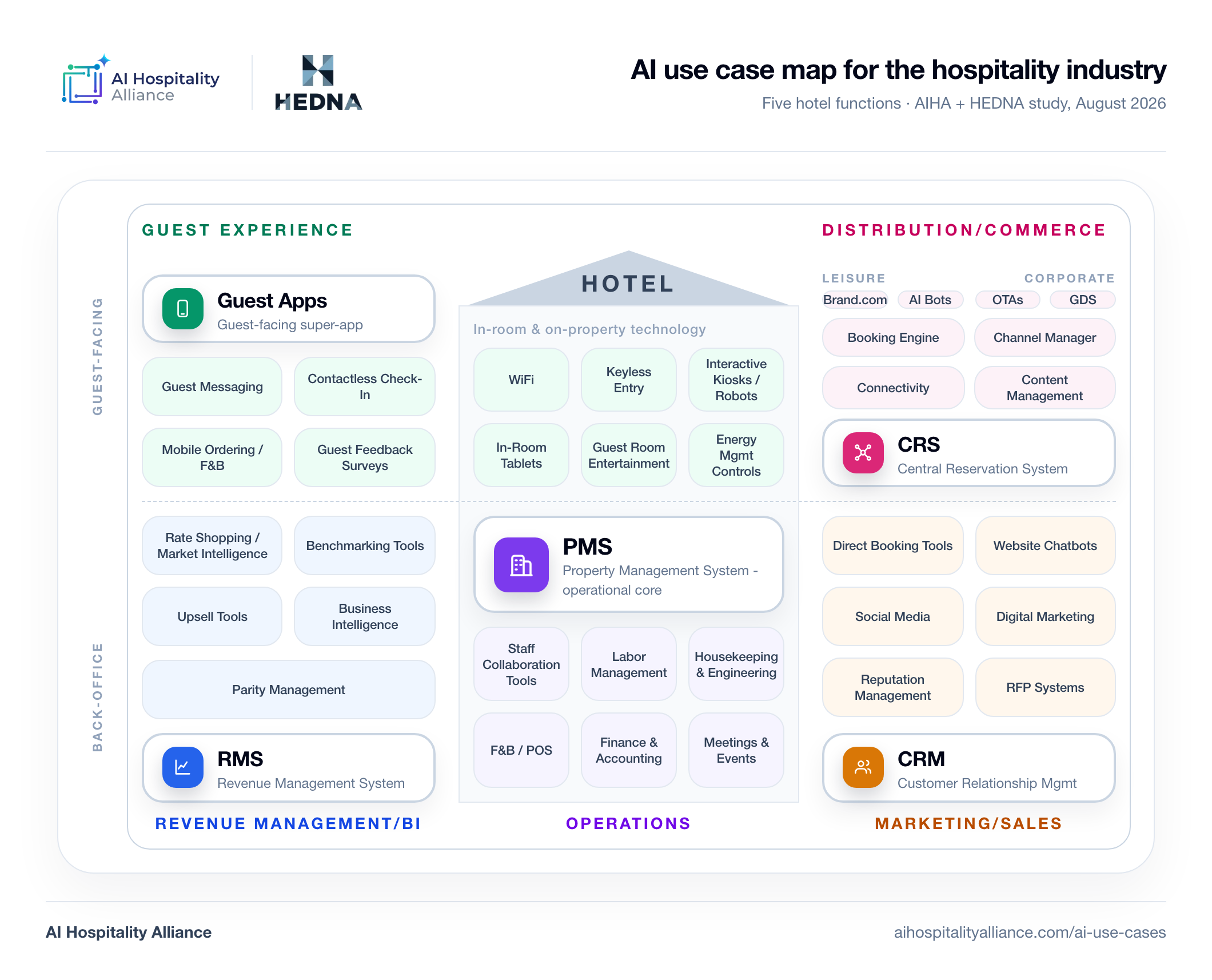
The AI Hospitality Alliance in partnership with HEDNA have launched the industry’s first comprehensive, crowdsourced catalogue of hospitality AI use cases.

  • Hoteliers, technology providers, consultants, and other industry professionals are invited to contribute real-world or pilot AI use cases.
  • Each submission takes approximately 60 seconds and helps collect a practical, industry-generated knowledge base.
  • Participants can select any system on the map and describe the business problem addressed, how AI is applied, and the benefits achieved.
  • Contributors may also identify the tools or technology providers involved.
NOW LIVE: The First Industry-Wide Crowdsourcing Initiative

AI Hospitality Alliance

Why It Matters For Our Industry

The catalogue creates a shared industry resource for understanding how AI is being applied across hotel functions. By connecting practical use cases to specific systems and operational challenges, it helps hospitality professionals identify opportunities, learn from industry peers, and make more informed technology decisions. The crowdsourced model also broadens access to practical AI knowledge and supports more collaborative innovation across the industry.

SkiftJuly 10, 2026

Airbnb Hires OpenAI's First Global Vice President of Creative

Airbnb has appointed Michael Tabtabai, OpenAI's first global VP of creative, as its new vice president of creative starting August 2026.

  • Michael Tabtabai helped build OpenAI's brand and marketing function before joining Airbnb.
  • He will start at Airbnb in August 2026, coinciding with his one-year anniversary at OpenAI.
  • Tabtabai previously held roles at Google before OpenAI.
  • Airbnb aims to leverage his expertise to develop technology with a distinct Airbnb brand identity.
Airbnb Hires OpenAI's First Global Vice President of Creative

Skift

Why It Matters For Our Industry

This hire indicates Airbnb's focus on integrating AI and technology with a strong brand identity, potentially differentiating its offerings from competitors like Booking.com and Expedia. Bringing in a creative executive from OpenAI suggests Airbnb is investing in in-house AI development rather than relying solely on external AI platforms, which may influence its strategic positioning in travel technology.

AnthropicJuly 9, 2026

Anthropic introduces a reflection feature for Claude AI usage

Anthropic launched a beta feature allowing Claude users to track and reflect on their AI usage patterns and task types over various time frames.

  • The reflection dashboard summarizes user activity, key topics, and task types over 1, 3, 6, or 12 months.
  • Users can set quiet hours and receive nudges to take breaks from Claude usage.
  • The feature supports the 4D AI Fluency Framework: Delegation, Description, Discernment, and Diligence.
  • Privacy measures exclude incognito chats and sensitive health-related conversations from reflection insights.
Anthropic introduces a reflection feature for Claude AI usage

Anthropic

Why It Matters For Our Industry

This feature provides users with data-driven insights to evaluate how they integrate AI into their workflows, potentially helping them balance AI assistance with personal input. It also emphasizes user control and privacy, which are important considerations for AI adoption and responsible usage.

openai.comJuly 9, 2026

OpenAI launches ChatGPT Work with GPT-5.6 for complex task automation

OpenAI introduces ChatGPT Work, now merged with Codex app, with multi-step task automation across apps and workflows, available on desktop and mobile for various subscription plans. Look at it as an equivalent of Claude Cowork. So you no longer need two different subscriptions to do cool things on your computer.

  • ChatGPT Work uses GPT-5.6 to handle complex workflows, creating documents, slides, and web apps from connected tools like Slack and Google Drive.
  • It supports Scheduled Tasks to automate repetitive work such as updating reports or monitoring feedback across apps.
  • The desktop app includes a built-in browser and Computer Use feature to execute tasks locally and online, merging Codex coding capabilities.
  • Enterprise and Edu admins can control access, usage, and security with compliance APIs and auto-review to prevent unauthorized actions.
OpenAI launches ChatGPT Work with GPT-5.6 for complex task automation

openai.com

Why It Matters For Our Industry

With Codex technology built-in, you move beyond answering questions to getting real work done across web, mobile, and desktop. This extends AI assistance from simple queries to managing complex, multi-step workflows across common business tools, changing how teams handle routine and strategic tasks. Its integration with enterprise controls addresses organizational security needs, while automation features may influence operational efficiency and task delegation.

HospitalityNetJuly 8, 2026

2027 Global Hotel Industry White Paper—The Robotics Revolution and Asset "Binary Divergence"

Rising labor costs and robotics adoption will split hotels into automated new builds and legacy properties converting to rentals over 20 years.

  • Labor costs pressure traditional hotel operations, prompting a shift to hardware automation for cost reduction.
  • Soft AI like revenue management offers small gains; hard AI robotics can cut operational costs by 30-40%.
  • New hotels built with automation infrastructure have 40% lower implementation costs than retrofitting older properties.
  • Legacy hotels face costly retrofits and may convert to minimal-service rentals, especially in mid-to-low-tier segments.
2027 Global Hotel Industry White Paper—The Robotics Revolution and Asset "Binary Divergence"

HospitalityNet

Why It Matters For Our Industry

The article highlights a structural shift in hotel operations driven by labor cost increases and robotics. New builds designed for automation gain lasting cost advantages, while legacy hotels risk losing competitiveness or converting to rentals. This bifurcation affects investment, operational strategy, and market composition globally, with regional differences in adoption timing and economic incentives.

Hospitality NetJuly 8, 2026

Navan and Hilton to Launch Direct Integration for Corporate Hotel Bookings

Navan will be the first TMC to integrate directly with Hilton's Central Reservation System, enabling real-time booking, rich content, and streamlined virtual payments for corporate travelers.

  • Navan and Hilton co-created a direct connection using Hilton's Booking and Content APIs for real-time hotel availability and booking.
  • This integration allows Navan to access authoritative Hilton property and room content, improving accuracy and traveler confidence.
  • The partnership supports streamlined virtual payments across Hilton's global portfolio, reducing friction for travelers and managers.
  • The collaboration aims to modernize hotel distribution and lays groundwork for future automation and post-booking enhancements.
Navan and Hilton to Launch Direct Integration for Corporate Hotel Bookings

Hospitality Net

Why It Matters For Our Industry

This direct integration between Navan and Hilton represents a shift from traditional hotel distribution models by enabling real-time, accurate booking data and content directly from Hilton's system. It may influence corporate travel booking processes by offering more reliable information and smoother payment options, potentially affecting how travel managers and travelers interact with hotel inventory and payments.

openai.comJuly 8, 2026

OpenAI launches GPT-Live, a new voice AI model for more natural conversations

OpenAI introduces GPT-Live, a voice AI model enabling continuous, natural conversations with simultaneous listening and speaking, using GPT-5.5 for deeper reasoning and web search.

  • GPT-Live uses full-duplex architecture to listen and speak simultaneously, allowing natural back-and-forth conversation.
  • It delegates complex tasks like web search and reasoning to GPT-5.5 while maintaining conversation flow.
  • GPT-Live outperforms previous voice modes in user preference and expert-level reasoning tests.
  • Safety features include real-time safeguards, crisis support, and protections for teen users, with ongoing monitoring planned.
OpenAI launches GPT-Live, a new voice AI model for more natural conversations

openai.com

Why It Matters For Our Industry

GPT-Live's continuous interaction and delegation architecture represent a shift from turn-based voice AI, potentially enabling more fluid and responsive conversations. This could affect how users engage with voice AI in hospitality and travel, offering more natural dialogue and multitasking capabilities while maintaining safety and content control.

x.aiJuly 8, 2026

SpaceXAI launches Grok 4.5 model optimized for coding and knowledge work

SpaceXAI released Grok 4.5, a model trained for coding, engineering, and office tasks, offering faster speeds and improved token efficiency compared to competitors.

  • Grok 4.5 was trained on datasets covering coding, science, engineering, and math, excelling in real engineering tasks.
  • It achieves faster speeds (80 TPS) and uses about 4.2 times fewer tokens than comparable models for task resolution.
  • The model supports complex office work, including Excel modeling, PowerPoint diagram creation, and Word prose writing.
  • Grok 4.5 is priced at $2 per million input tokens and $6 per million output tokens, with availability in Grok Build, Cursor, and SpaceXAI console, excluding the EU until mid-July.
SpaceXAI launches Grok 4.5 model optimized for coding and knowledge work

x.ai

Why It Matters For Our Industry

Grok 4.5's combination of coding proficiency, office task capabilities, and improved token efficiency suggests potential operational advantages in technical and administrative workflows. Its faster response times and lower token usage could influence cost and performance considerations for integrating AI in software development and office automation. However, the impact depends on adoption and specific use cases, with EU availability pending.

phocuswire.comJuly 7, 2026

Marriott advances technology replatforming and explores AI's role in distribution

Marriott is deploying new reservation and property management systems globally, enhancing booking options and exploring AI's impact on distribution and corporate travel partnerships.

  • Marriott has spent $1 billion over three years updating its reservation, property management, and loyalty systems, now deployed in 1,700 North American hotels.
  • New systems enable guests to select specific room features and book non-room products like spa and transportation in one cart.
  • Marriott collaborates with corporate travel partners to improve distribution and supports direct bookings with corporate travel managers.
  • AI is seen as an emerging channel for customer engagement, with Marriott preparing content and monitoring its impact on search and distribution strategies.
Marriott advances technology replatforming and explores AI's role in distribution

phocuswire.com

Why It Matters For Our Industry

Marriott's technology overhaul aims to enhance guest booking experiences and expand product offerings, reflecting a shift toward retail-like personalization. They are taking a cautious approach to AI integration. These developments may influence distribution strategies and corporate travel relationships amid evolving customer preferences and emerging technologies.

phocuswire.comJuly 7, 2026

Vibe and Navan launch Model Context Protocol (MCP) servers for AI-enabled travel management

Navan and Vibe have launched MCP servers enabling AI platforms to access travel data and booking functions through conversational prompts and integrations.

  • Navan's MCP server currently offers read-only access to travel data via AI platforms like ChatGPT and Claude, with plans to add booking and policy update functions.
  • Navan is partnering with Hilton to integrate Hilton's reservation system and content APIs directly with Navan's platform.
  • Vibe's MCP server allows corporate travelers to book and manage travel through AI platforms while maintaining TMC-approved content and processes.
  • UK-based ITG Business Travel is Vibe's first client using the MCP technology, testing it with corporate customers to compete in the AI travel landscape.
Vibe and Navan launch Model Context Protocol (MCP) servers for AI-enabled travel management

phocuswire.com

Why It Matters For Our Industry

The launch of MCP servers by Navan and Vibe introduces AI-driven interfaces for travel management, potentially changing how travel data is accessed and bookings are made. These developments could influence TMC operations and client interactions by integrating AI conversational tools without replacing traditional management companies, though the full impact on workflows and market dynamics remains to be seen.

SkiftJuly 6, 2026

AI Travel Chatbots Often Bypass Connected Travel Apps, Skift Tests Find

Skift tests reveal AI travel chatbots like ChatGPT sometimes ignore connected travel apps, while Claude integrates them more smoothly, affecting referral paths for travel brands.

  • Travel apps inside AI chatbots can provide branded results, prices, and booking options when connected.
  • Users must first connect the app and the chatbot must recognize and choose to use it, which is a hurdle.
  • Claude's AI chatbot handled app integrations better than ChatGPT, which often bypassed or denied connected apps.
  • Major travel brands like Booking.com, Expedia, and Viator experienced initial issues with ChatGPT not using their connected apps without extra prompting.
AI Travel Chatbots Often Bypass Connected Travel Apps, Skift Tests Find

Skift

Why It Matters For Our Industry

This finding highlights a challenge in AI-driven travel planning: even when travel apps are connected to chatbots, they may not be utilized consistently. This inconsistency can disrupt referral traffic and affect how travel brands engage with customers through AI platforms, indicating a need for improved integration and user experience in chatbot-app connections.

Hotel News ResourceJuly 6, 2026

German Court Rules Google Liable for False AI-Generated Search Summaries

A German court ruled that Google's AI-generated summaries are Google's own statements, making Google liable for false information, impacting how hotels manage AI search reputations.

  • The Regional Court of Munich decided Google's AI Overviews are independent statements, not neutral search results, holding Google directly responsible for inaccuracies.
  • The case involved false claims linking two publishers to scams, with the court rejecting Google's defense that users could verify info via links.
  • The ruling distinguishes AI-generated answers from traditional search results, which typically have broader liability protections for search engines.
  • Hotels may be affected as AI summaries influence traveler perceptions, requiring active monitoring and management of AI-generated brand information.
German Court Rules Google Liable for False AI-Generated Search Summaries

Hotel News Resource

Why It Matters For Our Industry

This ruling signals a shift in legal responsibility for AI-generated content, emphasizing that platforms like Google could be held accountable for inaccuracies. Hotels must now consider AI-driven search narratives as part of reputation management, monitoring AI outputs closely to address potential misinformation that could affect bookings and brand perception.

The State of Illinois NewsroomJuly 6, 2026

Illinois Governor Signs Nation-Leading Artificial Intelligence Safety Law

Illinois enacts SB 315, establishing the nation's strongest AI safety framework with transparency, accountability, and independent audits for large AI developers.

  • SB 315 requires large AI developers to disclose safety practices, report incidents, and maintain compliance processes.
  • The law includes whistleblower protections and confidential channels for AI safety concerns.
  • Illinois mandates independent third-party safety audits of covered AI systems, a first in the U.S.
  • The bipartisan law takes effect January 1, 2027, aiming to balance innovation with public safety and accountability.
Illinois Governor Signs Nation-Leading Artificial Intelligence Safety Law

The State of Illinois Newsroom

Why It Matters For Our Industry

This law sets a precedent for state-level AI regulation by imposing transparency and safety requirements on major AI developers, including independent audits. It addresses risks from advanced AI systems amid limited federal oversight, potentially influencing how AI safety and accountability are managed in technology development and deployment.

Pudu RoboticsJuly 6, 2026

Pudu Robotics and Shenzhen CTID Co. Ltd Launch Full-Scenario Robot-Serviced Hotel Project

Pudu Robotics and Shenzhen CTID Co. Ltd have initiated the world's first hotel project fully serviced by robots across all scenarios.

  • The project represents the first hotel fully serviced by robots in all operational scenarios.
  • It is a collaboration between Pudu Robotics and Shenzhen CTID Co. Ltd.
  • The launch date of the project is June 1, 2026.
  • The initiative aims to integrate robotic services throughout the hotel environment.
Pudu Robotics and Shenzhen CTID Co. Ltd Launch Full-Scenario Robot-Serviced Hotel Project

Pudu Robotics

Why It Matters For Our Industry

This development marks a notable step in integrating robotics into hospitality operations, potentially affecting hotel service models and operational workflows. However, the article does not provide evidence on impacts to efficiency, guest experience, or financial outcomes, so the practical implications remain to be observed.

x.comJuly 6, 2026

Weave Robotics launches home robot Isaac 1 with deliveries starting this fall

Weave Robotics announced the launch of its home robot Isaac 1, with deliveries scheduled to begin in the fall of 2026.

  • The home robot Isaac 1 was officially launched by Weave Robotics on July 1, 2026.
  • Deliveries of Isaac 1 are planned to start in the fall season of 2026.
  • Customers can place orders for Isaac 1 through the provided online link.
  • The announcement included a video showcasing the robot's features and capabilities.
Weave Robotics launches home robot Isaac 1 with deliveries starting this fall

x.com

Why It Matters For Our Industry

The introduction of Isaac 1 represents a new entrant in the home robotics market, potentially influencing how hospitality and home services integrate automation. While specific functions are not detailed, the availability of such robots could affect operational decisions and guest interactions in residential and hospitality environments, depending on adoption and capabilities.