
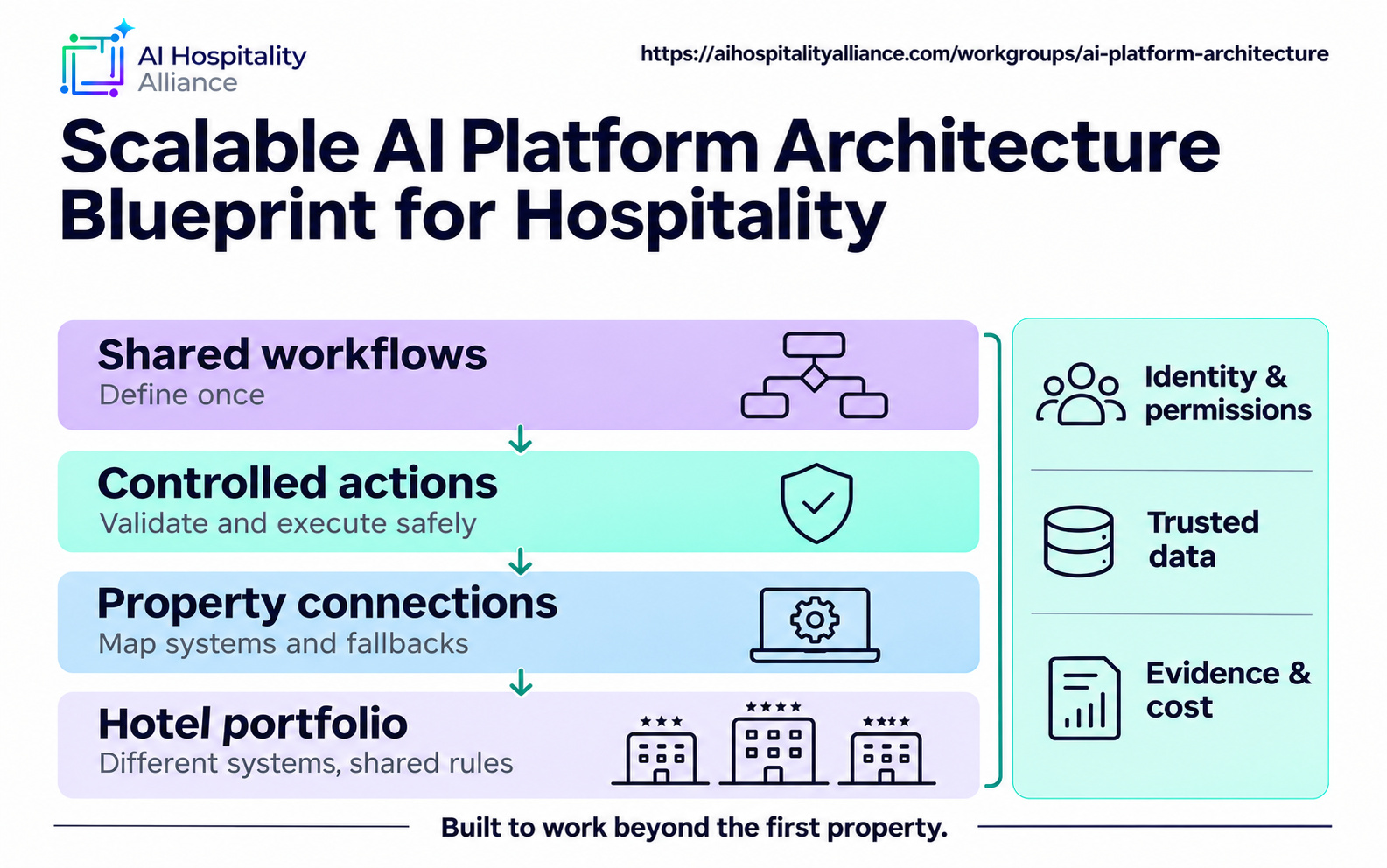
SAN DIEGO, Calif. – The AI Hospitality Alliance (AIHA) announced the release of the Scalable AI Platform Architecture Blueprint for Hospitality, a comprehensive, industry-developed guide designed to help hotel companies, owners, operators and technology providers build AI platforms capable of operating reliably across diverse hotel portfolios.
Available free of charge, the blueprint provides a practical architectural foundation for moving beyond isolated AI pilots toward scalable, enterprise-wide deployments. It addresses the unique challenges of hospitality technology environments, where properties operate different systems, brands and owners control different parts of the technology stack, and AI solutions must perform consistently across hundreds of locations.
The blueprint considers three distinct operating environments:
- multi-brand management companies
- hotel brands operating relatively uniform portfolios
- franchisors managing distributed ownership structures
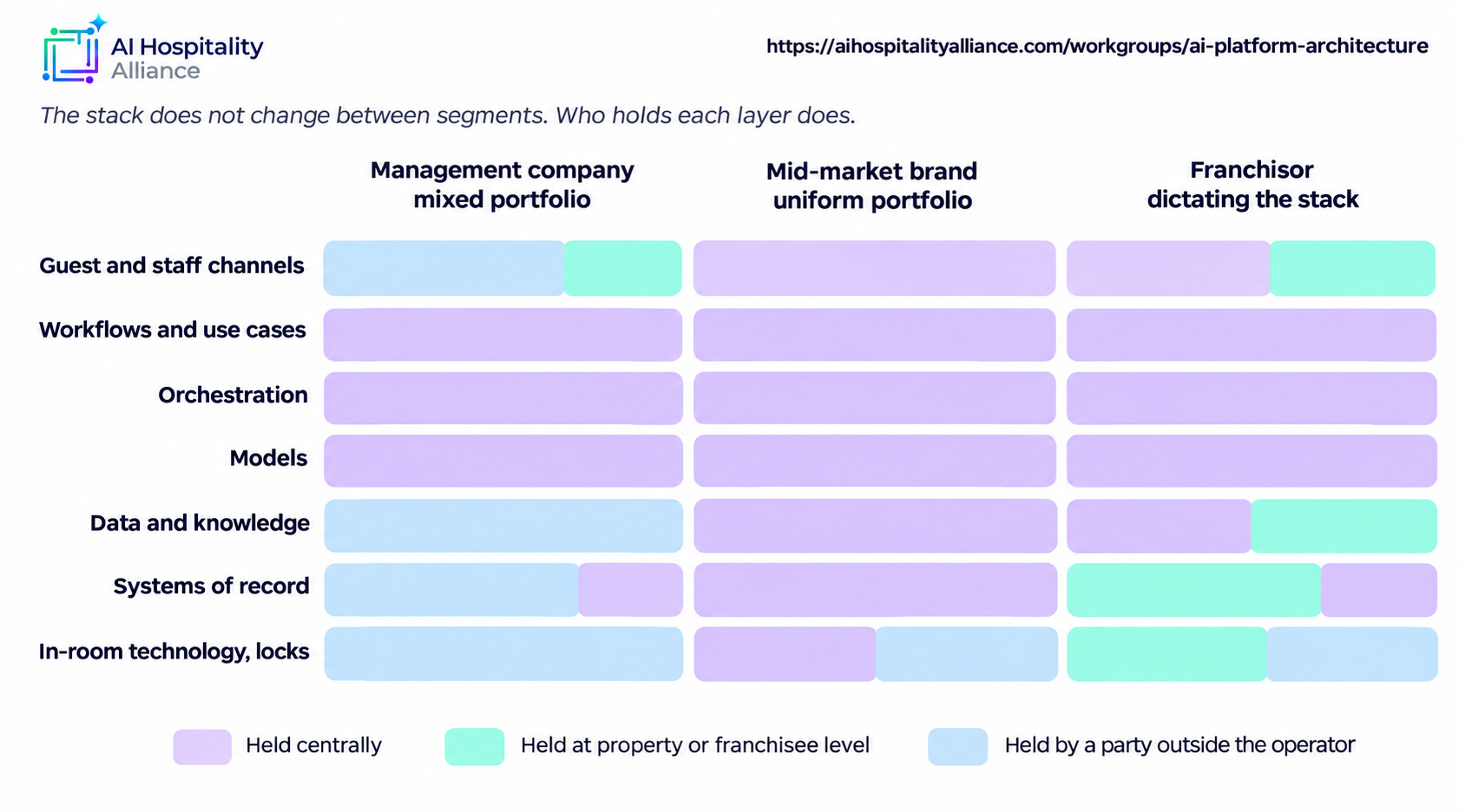
Rather than prescribing a specific technology vendor, cloud infrastructure or AI model, it provides a common architectural approach that organizations can adapt to their existing systems and operating models.
As artificial intelligence becomes increasingly embedded in hotel operations, distribution and guest experiences, the industry faces a fundamental challenge: How do we build AI capabilities that work not just at one hotel, but across an entire portfolio without rebuilding them for every property?
The new blueprint helps organizations answer critical questions: How should AI capabilities be distributed between corporate and property levels? Who controls access to hotel systems and guest data? How can multiple AI agents interact safely with existing technology? How should organizations measure scalability, performance and operating costs? And how can AI platforms accommodate new properties, changing systems and evolving technology without constant redevelopment?
"The hospitality industry doesn't need another collection of impressive AI demos. We need an architecture that actually works in the real world," said Ira Vouk, Founder of the AI Hospitality Alliance. "A solution that works at one hotel is not necessarily a solution that works at 500 hotels, each with its own technology stack, operational requirements and ownership structure. This blueprint gives our industry a practical foundation for bridging that gap."
A Practical Blueprint for Scalable Hospitality AI
Developed through AIHA's collaborative industry workgroup, the guide organizes the essential architectural decisions into ten practical steps, addressing:
- Authority and Access Control – Establishing who can authorize AI access and actions across brands, management companies, franchisees and individual properties.
- Shared vs. Property-Level Capabilities – Determining which AI functions should be centralized, localized or shared across a portfolio.
- Trusted Data and Systems of Record – Defining authoritative sources for guest information, reservations, pricing and operational data while preserving data integrity.
- Vendor-Neutral Workflows and Integration – Creating reusable AI workflows that can operate across different property management systems and technology vendors without requiring individual redevelopment.
- Safe and Accountable AI Agents – Establishing controlled execution, permissions, auditability and clear decision authority when multiple AI agents interact with hotel systems.
- Hospitality-Specific Operational Requirements – Addressing real-world scenarios such as night audits, group bookings, reservation changes, system migrations and guest transfers.
- Scalability, Performance and Economics – Measuring the actual operational and financial impact of AI deployments, including cost per successful outcome, reliability, onboarding effort and model flexibility.
Designed for Practical Adoption
The blueprint goes beyond architectural concepts to provide actionable tools that hospitality organizations can begin using immediately.
Resources include:
- Control Boundary Matrix – A structured tool for documenting authority, permissions, data ownership and operational responsibilities across different hotel operating models.
- Capability Checklist – A practical framework for determining where AI capabilities belong, assessing deployment prerequisites and recording implementation decisions.
- Property Bindings Table – A reusable approach to connecting common AI workflows to different hotel technology systems, including access permissions and fallback options.
- Seven Scaling Gates – A measurable assessment framework covering AI operating costs, human escalation, evaluation coverage, model resilience, property onboarding, deployment reach and offboarding.
The guide also includes hospitality-specific examples, architecture diagrams, readiness questions and implementation considerations designed to support conversations between business leaders, technology teams and solution providers.
While developed with the complexity of enterprise hospitality portfolios in mind, its principles can also help smaller hotel groups establish scalable foundations as their AI capabilities expand.
Industry Collaboration Driving Practical Standards
The blueprint was developed through AIHA's industry-led collaborative workgroup, bringing together hospitality technology leaders, architects and AI specialists with experience spanning hotel operations, enterprise architecture, AI platforms and technology integration.
Contributors included experts from organizations such as AWS, Sirma Travel and Hospitality, Polydom.ai, DominateAI, Milestone and others, combining diverse technical and operational perspectives to develop an approach grounded in hospitality's real-world requirements.
"What makes this work particularly valuable is the collaboration behind it," Vouk added. "We brought together experts with different backgrounds, perspectives and areas of specialization to address challenges that no single hotel company or technology vendor can solve alone. Instead of developing another proprietary approach, we are creating shared, open resources that the entire industry can build upon."
The blueprint complements AIHA's previously released Hospitality AI Governance Framework and AI Orchestration Framework for Hospitality, contributing to the Alliance's growing collection of practical industry resources for responsible AI adoption.
Together, these publications help hospitality organizations address not only what AI should be permitted to do, but also how AI systems can be designed, connected, operated and scaled safely across the industry's fragmented technology landscape.
"Our goal is to move the hospitality industry from talking about AI to actually implementing it successfully," Vouk said. "That requires more than technology. It requires shared principles, practical architecture, industry collaboration and measurable outcomes. This guide is another step toward giving hospitality organizations the tools they need to make that happen."
The Scalable AI Platform Architecture Blueprint for Hospitality, including its supporting diagrams, implementation tools and downloadable resources, is available free of charge at:
https://aihospitalityalliance.com/workgroups/ai-platform-architecture
About AI Hospitality Alliance
AI Hospitality Alliance brings hospitality organizations, technology providers, educators, and AI specialists together to advance responsible AI adoption. Its work spans education, research, technical guidance, and collaborative industry initiatives, helping hospitality professionals prepare for and participate in the changes AI brings.
Learn more at joinAIHA.com.
Media Contact
Ira Vouk
Founder and CEO, AI Hospitality Alliance
[email protected]