

This insight is based on George Roukas's April 2026 Hospitality Net article, The Silent Build of the Agentic Web and the Coming Shift in Travel Distribution, and summarizes its core argument for hospitality leaders.

Roukas's central point is that many hotel executives are misreading the current state of AI in travel. Because consumer-facing chatbots still produce inconsistent recommendations and incomplete booking flows, some assume that agentic commerce is overhyped or moving slowly. His view is the opposite: the visible experience is still uneven, but the underlying infrastructure is being assembled quickly, and that is the part that matters most.
The article argues that the real build-out is happening beneath the consumer surface. Instead of focusing only on chat interfaces, leaders should pay attention to the standards, registries, governance layers, and orchestration patterns that allow AI agents to access tools, coordinate with other agents, and eventually complete commercial tasks reliably. Roukas points to MCP as a foundational layer for connecting models to external systems, A2A as a framework for agent-to-agent coordination, and emerging payment infrastructure as the missing financial rail. In his framing, these are not flashy announcements; they are plumbing. But plumbing determines which companies are ready when consumer behavior tips.
One of the article's most useful distinctions is between the human web and the agentic layer. The traditional web is built around attention, clicks, ads, pages, and conversion funnels. The emerging agentic layer is built around machine-readable data, APIs, structured context, and outcome optimization. Humans browse; agents query. Humans respond to persuasive interfaces; agents do not. That means much of the design and marketing machinery built for web-era discovery becomes less relevant inside agent-mediated decision flows, while structured content, trust, permissions, and routing logic become more important.
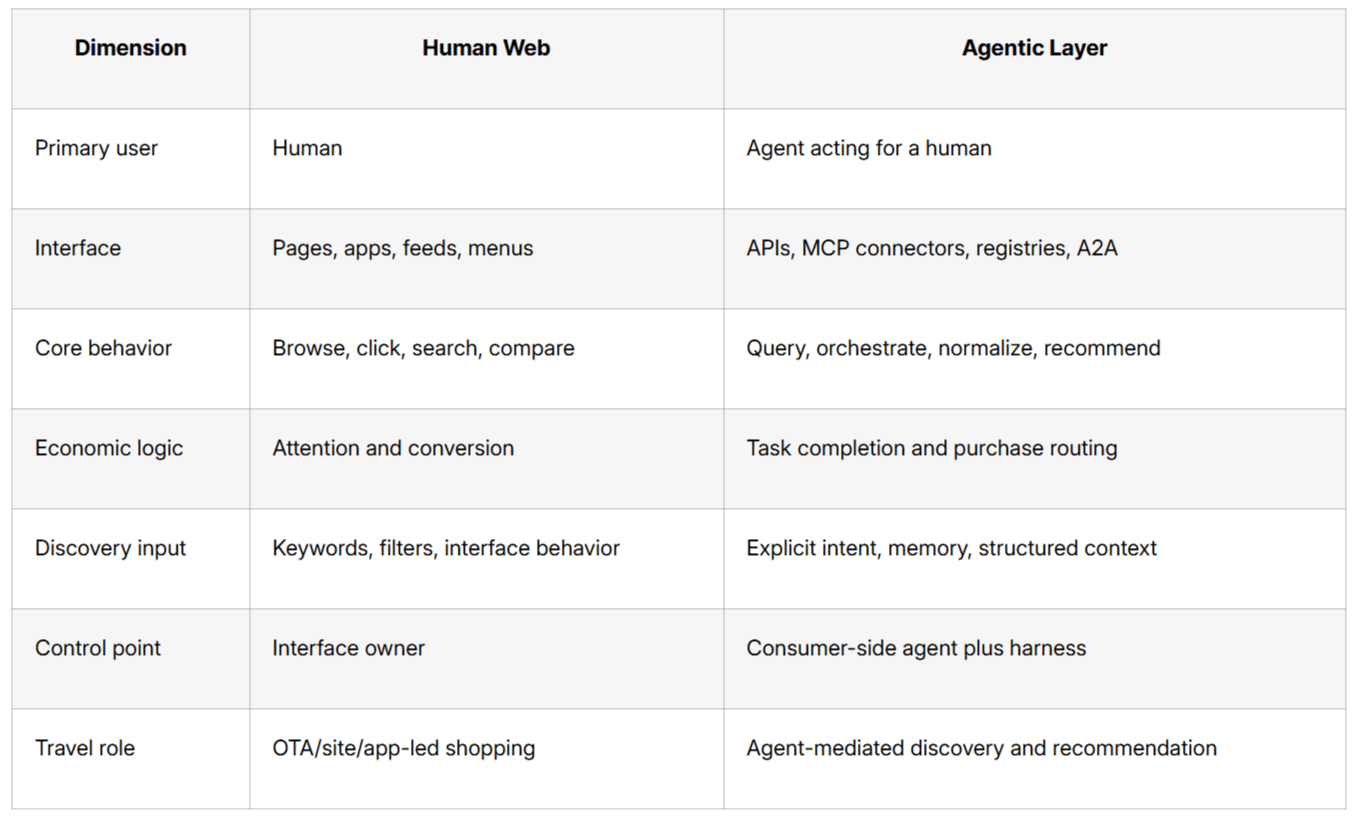
Roukas also argues that control is moving away from whoever owns the visible interface and toward whoever controls the consumer-side agent plus its harness: the tools, policies, memory, rules, and data sources that shape what the agent recommends. That is why this shift matters so much for hotel distribution. In the OTA era, intermediaries won because they controlled visibility and comparison. In the agentic era, similar power could concentrate with the platforms that control the traveler-facing agent environment unless suppliers build infrastructure that makes their own offers easy for agents to access and evaluate.
The article rejects the idea that travel is somehow too complex for AI to handle. Roukas argues that travel complexity is real but not unique in a way that protects incumbents. Compared with domains where AI is already proving its value, hotel distribution is a solvable problem as long as agents can access the right systems and context. What matters, then, is not whether agents are cognitively capable enough, but whether the industry has prepared the technical rails they need.
For suppliers, the takeaway is practical rather than theoretical. Investments in structured data, offer management, personalization, and agent-accessible infrastructure improve the human web today while also preparing hotels for future agentic channels. For OTAs, the near-term advantage is obvious: many have already built the structured, machine-readable distribution layer that agents can use. For hotels that wait until autonomous booking is mainstream, the risk is that the next distribution shift will already be structurally decided.
Original article: Hospitality Net