
What hoteliers need to know before building their first "digital employee"
There's a lot of noise right now around "AI agents." And if you've been nodding along in meetings pretending you fully get the difference between an assistant and an agent, you're not alone. So let's simplify this in plain hospitality terms. Because this isn't just semantics. It's a fundamental shift in how work gets done in our industry.
99% of people using AI today are still using it as an assistant, tapping into maybe 1% of what AI can actually do. There's a massive gap between that and what's possible with AI agents, and most of it is accessible today without special skills or heavy investment. The small group of people who have learned to integrate agents into their workflows are already operating at a completely different level, often 10x to 100x more productive than everyone else. Same tools. Completely different mindset.
The real shift isn't about using AI more. It's about using it differently.
What's an AI Assistant?
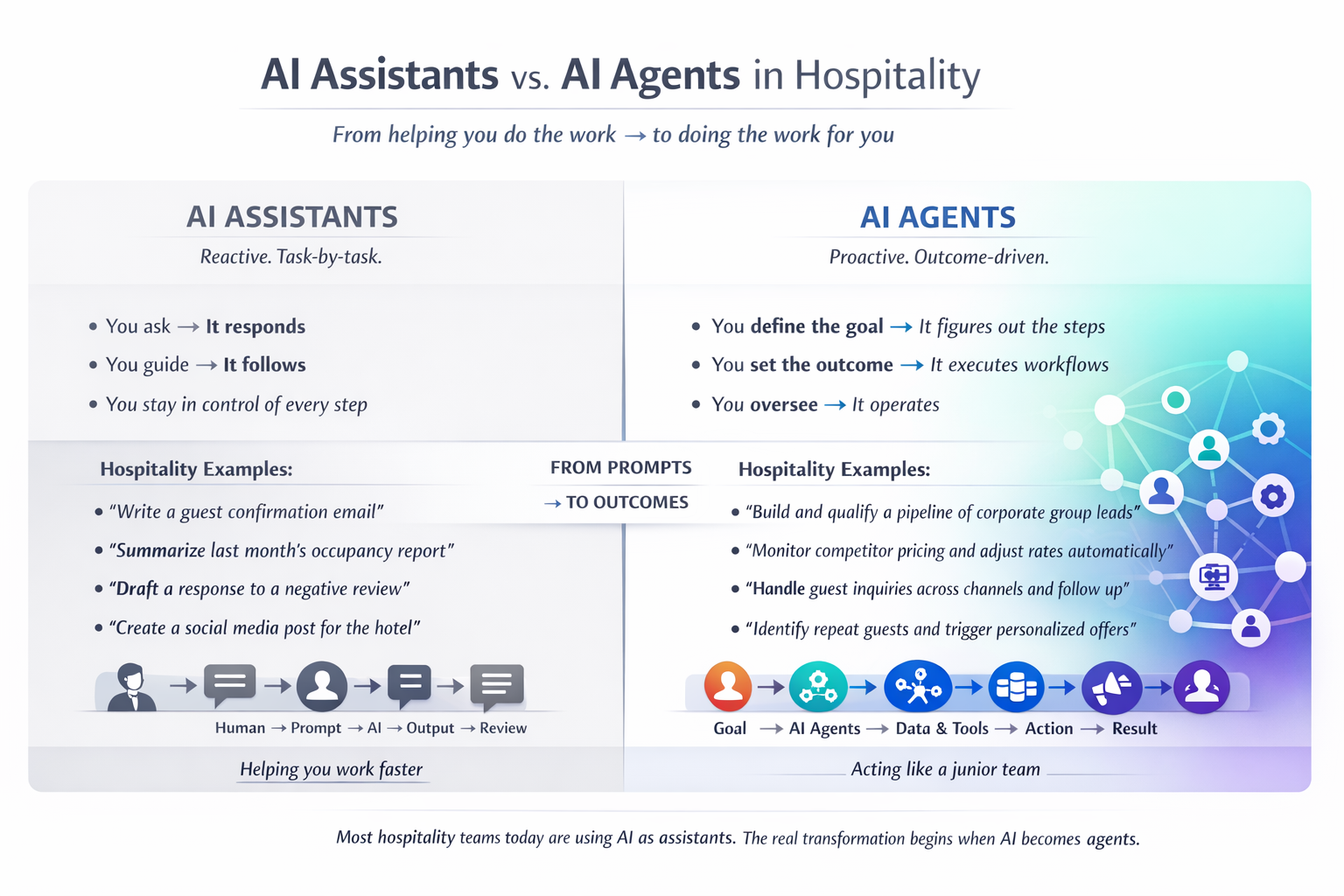
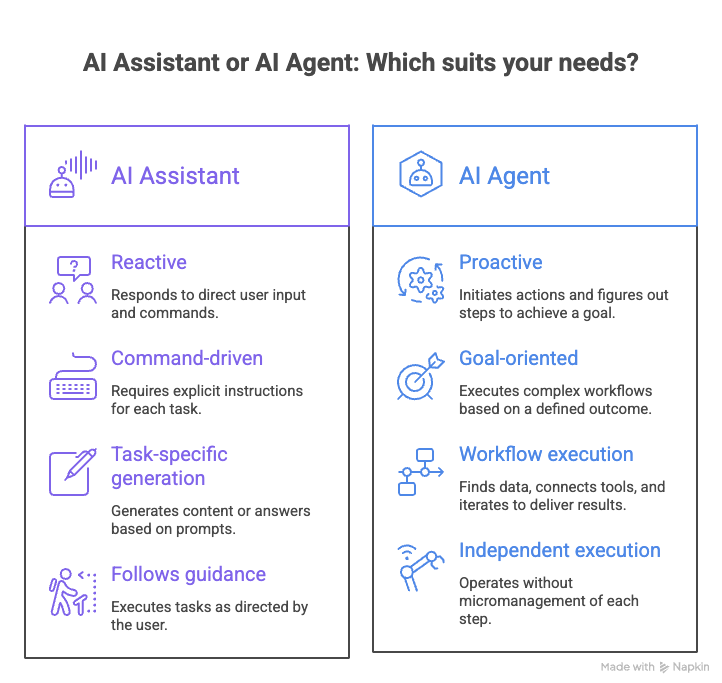
An AI assistant is reactive.
- You ask and it answers.
- You prompt and it generates.
- You guide and it follows.
Think of tools like ChatGPT, Claude, or Gemini as your very fast, very capable intern who writes emails, summarizes reports, drafts marketing copy, and helps you think, but still needs you to tell it what to do, guide each step, and review everything.
It's the intern that works at lightning speed but still looks at you after every task like, "What next?"
It helps you do the work.
What's an AI Agent?
An AI agent is proactive and independent.
- You define the goal and it figures out the steps.
- You set the outcome and it executes the workflow.
Instead of "Write me a sales email," you say: "Build a pipeline of corporate group leads in San Diego, qualify them, draft outreach, and prepare follow-ups."
And it finds data, connects tools, runs sequences, iterates, and delivers results without you micromanaging every step.
- No "what next?"
- No waiting for instructions.
- No hovering over its shoulder like a very stressed-out supervisor.
This is not an assistant. This is a junior, and sometimes surprisingly competent, team.
"This Sounds Expensive and Complicated"
It's not. You don't need a dev team, custom software, or a six-figure budget. This has already been productized and democratized by tools like Claude, Perplexity, Zapier, n8n, Manus, and a growing list of hospitality-specific startups.
You can literally start today. Not in six months after IT approves it.
Today.
How to build your first agent in 10 minutes
- Install Claude on your desktop and sign up for the Pro plan. You can also try Perplexity Computer, Manus, or similar tools.
- Give it a goal: "Build a list of corporate group prospects in San Diego and draft outreach emails."
- Ask it what information it needs from you.
- Let it structure the workflow, suggest tools, and generate outputs.
- Review the result.
- If it's good, automate or repeat.
- Then scale it. Create one agent for marketing, one for sales, and one for reporting.
- Once you have 5 to 10, build a "manager" agent that checks outputs, flags issues, and summarizes performance.
Congratulations. You now have an orchestrated system of agents. Also known as a team that doesn't ask for PTO.
The shift: from managing tasks to defining outcomes
This is where it gets interesting for hospitality. Historically, our industry has been built on processes: SOPs, checklists, manual workflows, and a deep emotional attachment to "this is how we've always done it." AI agents flip this completely.
You don't manage steps anymore. You define outcomes. Instead of "Pull this report, analyze it, create slides, and send to leadership," you say: "Give me a weekly performance narrative with key risks and opportunities." And the agent figures out how to get there.
Which means your job changes. Your new role becomes architect, not operator.
If you adopt agents, your team is no longer doing the grunt work. They're designing logic, setting standards, defining success criteria, and reviewing outputs. In other words, you stop being the person doing the work and become the person designing how work gets done.
Less operator. More systems architect with opinions.
So who's responsible when it messes up?
You are. Always.
And this is a critical point that gets misunderstood. AI agents do not own outcomes. Humans do, by design. Any action that has financial impact, legal implications, or guest experience consequences should, and will, require explicit human approval.
So no, you are not getting replaced.
You are getting promoted to reviewer, decision-maker, and accountability holder.
Which is honestly what leadership roles were supposed to be all along.
AI agents are not here to replace people. They are meant to function like a dedicated team of specialists working under you. Think one agent for prospecting, one for marketing campaigns, one for pricing analysis, and one for guest communication. Individually useful. Together, you've just built a digital department.
Where this hits hospitality first, and where it doesn't
1. AI agents remove the advantage of scale
Historically, big brands win because they can afford large sales teams, marketing departments, analysts, and agencies. Now, a small independent hotel can deploy 5 to 10 agents running 24/7 across the same functions.
Which means the competitive advantage shifts from who has more people to who designs better systems. And smaller, more agile companies are often better positioned to win that game.
2. AI is getting very good at reasoning, but it still lacks physical grounding
In hospitality, that matters.
Agents cannot clean a room, fix a broken AC, handle a guest meltdown at the front desk, or deliver actual service. So the industry doesn't become less human. It becomes digitally automated and physically human.
Which is actually exactly what hospitality should be.
Final thought
AI assistants help you do your job faster.
AI agents change what your job actually is.
And in hospitality, that shift is going to separate companies that automate tasks from companies that redesign how their business runs.
The second group wins.
Not because they have better AI, but because they understand what to do with it.